
TL;DR
Stock photos work best for generic backgrounds, filler visuals, and low-risk editorial needs. Custom AI portraits are stronger when trust, recognition, and personal credibility matter, especially for LinkedIn profiles, founder pages, creator brands, and service businesses.
Generic imagery is easy to buy, but trust is harder to earn. The choice between stock photos vs custom AI portraits now affects more than visual style: it shapes recognition, credibility, profile performance, and how real a brand feels to a cautious audience. Stock photography: the licensed supply of photographs for specific uses, usually sold through image libraries. Custom AI portraits: personalized, synthetic portraits generated from an individual's images or detailed prompts to create branded headshots or profile visuals. For professionals who need polished personal imagery without a traditional shoot, Looktara offers a practical way to create custom AI portraits for career, business, and creator profiles.
Table of Contents
What are stock photos and custom AI portraits?
Stock photos are pre-existing licensed images, while custom AI portraits are personalized synthetic images designed around a real person, brand style, or use case. Stock libraries solve speed and availability; AI portrait tools solve identity, consistency, and personal credibility when a face needs to represent a specific professional.
Stock photos: ready-made photographs licensed for websites, ads, presentations, blogs, and social posts.
Custom AI portraits: generated portraits made to resemble a specific subject or fit a defined brand direction, often used for LinkedIn, portfolios, speaker bios, dating profiles, and founder pages.
Key insight: Stock imagery fills visual space; custom portraiture carries personal trust.
Research on synthetic media shows why the distinction matters. A 2022 article in the Journal of Business Research examined deepfakes, deception, mitigation, and opportunity, highlighting that AI-generated visuals create both business value and trust challenges when identity is involved: Deepfakes: Deceptions, mitigations, and opportunities.
The practical difference is simple: stock photos are about category representation, while custom AI portraits are about individual representation. A generic "business person on laptop" image can support a blog post. A recognizable founder portrait, career headshot, or creator profile image needs specificity.
Stock photos vs custom AI portraits: quick comparison
Custom AI portraits are usually the better choice when a person's credibility affects the outcome, while stock photos remain useful for generic scenes, backgrounds, and low-touch content. The strongest decision factor is whether the image must represent a real identity or simply illustrate an idea.
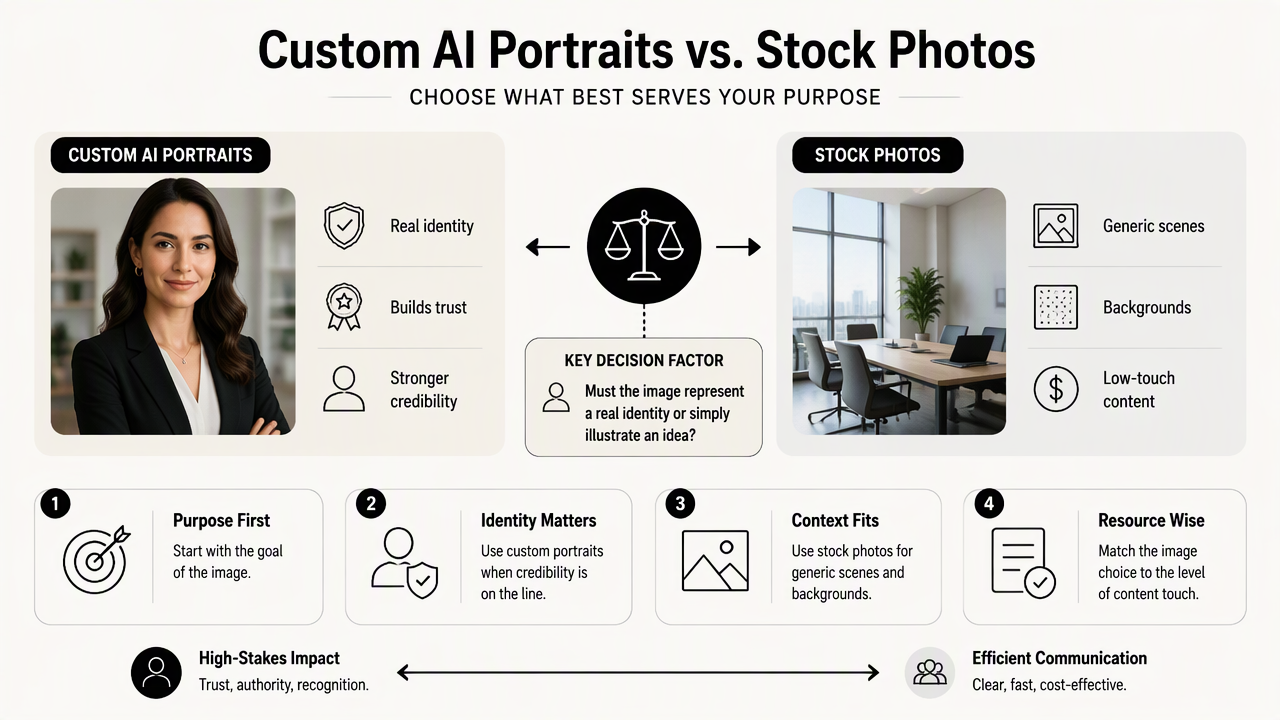
Comparison table for 2026 visual decisions
| Factor | Stock photos | Custom AI portraits | Better choice |
|---|---|---|---|
| Authenticity | Can feel familiar or overused | Can reflect a specific person and style | Custom AI portraits |
| Cost | Often low per image, subscriptions common | Varies by tool, usually lower than full photo shoots | Depends on volume |
| Brand consistency | Limited by available images | Easier to match clothing, mood, background, and platform needs | Custom AI portraits |
| Licensing | Clear if purchased from reputable libraries | Requires review of tool rights and model permissions | Tie, if terms are clear |
| SEO trust | Supports articles and landing pages visually | Strengthens author, team, and profile signals | Custom AI portraits |
| Conversion impact | Works for broad concepts | Stronger when trust, recognition, or expertise matters | Custom AI portraits |
| Speed | Immediate download | Fast generation, plus review time | Stock photos for instant use |
| Uniqueness | May appear on other sites | More distinctive when generated carefully | Custom AI portraits |
Stock photography still has a place because not every visual needs a human identity. Blog headers, abstract concepts, seasonal campaigns, and presentation decks can work well with licensed images.
Custom AI portraits win when repetition harms credibility. Career professionals, entrepreneurs, coaches, freelancers, influencers, and dating app users often need a visual that feels specific rather than interchangeable.
For product-led content, the same principle applies to scene control. A brand creating fitness or wellness visuals, for example, may need consistent lighting, mood, and composition across channels; a specialized tool such as the fitness Pinterest product photo AI generator can support that kind of repeatable visual direction.
When do stock photos still make sense?
Stock photos still make sense when the image does not need to prove identity, ownership, personal expertise, or lived experience. They remain practical for fast content production, broad editorial ideas, background visuals, and campaigns where the message matters more than the person pictured.
A good stock image can support a page without becoming the point of the page. The problem starts when a business uses generic faces to imply real customers, real employees, or real service providers.
Best-fit uses for stock photography
- Blog headers: broad topics such as productivity, travel, finance, or wellness.
- Presentation slides: visual pacing where originality is less important.
- Background textures: desks, offices, landscapes, objects, and abstract scenes.
- Editorial explainers: articles that need concept support rather than personal proof.
- Early-stage mockups: placeholder imagery before final creative direction is set.
Stock images also help when speed is the main constraint. A licensed image can be selected, downloaded, and placed in minutes, which matters for newsy posts or internal decks.
Still, overused stock faces can weaken credibility. If the same smiling consultant appears across unrelated websites, the image may signal convenience rather than expertise.
Rule of thumb: Stock photos are safest when they illustrate a concept, not when they pretend to represent a real person, team, or result.
Licensing deserves careful review. Rights vary by platform, image type, territory, redistribution rules, and commercial use. A downloaded file is not the same as unrestricted ownership, especially for ads, templates, merchandise, or client work.
When are custom AI portraits stronger?
Custom AI portraits are stronger when recognition, personal branding, and trust influence the viewer's decision. They are especially useful for professional profiles, founder pages, creator media kits, speaker bios, sales pages, dating apps, and remote-first teams that need polished imagery at scale.
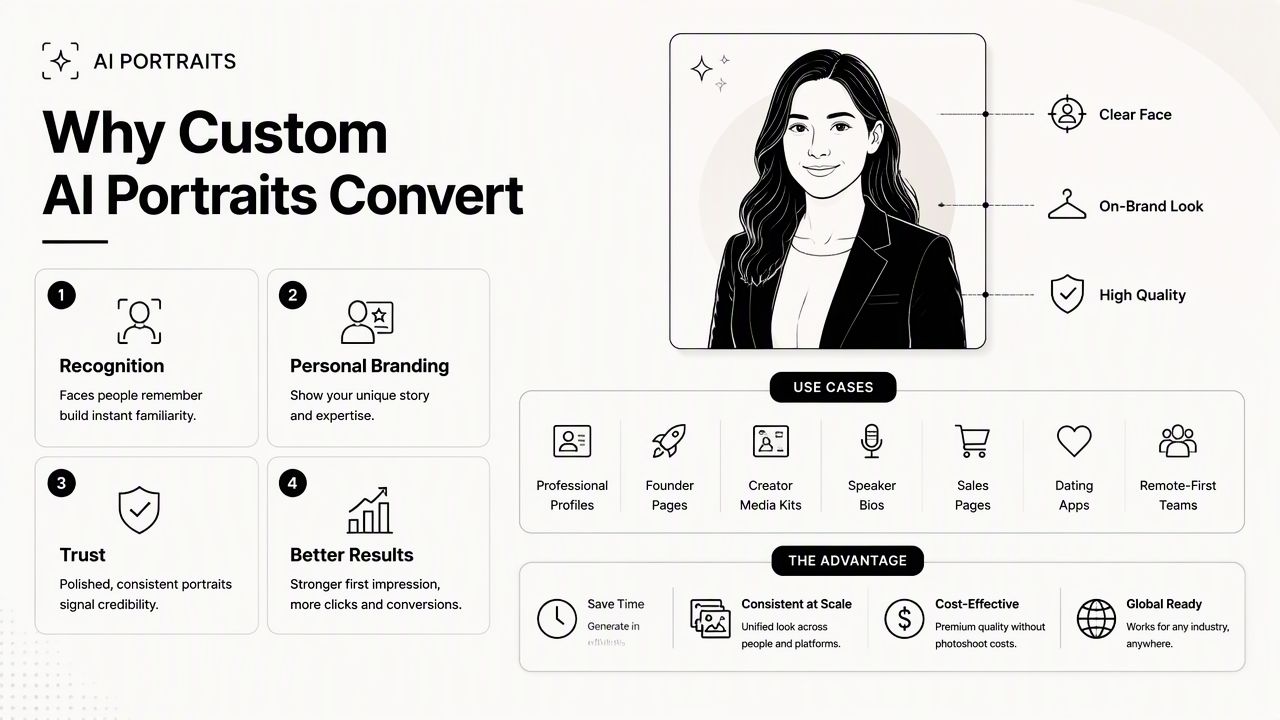
The advantage comes from relevance. A portrait tied to a real person can carry signals that generic imagery cannot: role, style, confidence, approachability, and consistency across platforms.
High-trust use cases for AI portraits
- LinkedIn and job search profiles: recruiters assess professionalism quickly from visual cues.
- Founder and consultant pages: service buyers often want to see the person behind the offer.
- Creator and influencer kits: consistent portraits help a personal brand feel recognizable.
- Remote team directories: distributed companies can create a cleaner visual standard.
- Dating profiles: authentic-looking, current portraits usually feel more useful than staged stock-like images.
A 2022 arXiv paper on synthetic data explained the broader "what, why, and how" of generated data, including the value of creating data-like outputs for practical tasks: Synthetic Data -- what, why and how?. Portrait generation is not the same as research datasets, but both belong to the larger shift toward synthetic assets built for specific use cases.
How Looktara handles this
The Looktara platform focuses on custom AI portraits for people who need polished images without arranging a studio session. That fits professionals refreshing LinkedIn, entrepreneurs building a founder brand, creators updating social profiles, and remote workers standardizing online presence.
Good AI portrait workflows should provide variety without making the subject unrecognizable. Strong outputs usually preserve face structure, age range, and personal style while improving lighting, framing, clothing, and background quality.
The strongest portrait set often includes several versions, not just one hero image:
- Professional headshot: clean background, direct eye contact, business-friendly clothing.
- Warm personal portrait: softer expression for about pages or social profiles.
- Creative brand image: more stylized lighting or setting for creators and founders.
- Platform-specific crop: square, vertical, and horizontal versions for different placements.
What should brands watch for in 2026?
Brands should watch for authenticity, disclosure norms, licensing clarity, likeness consent, and consistency across channels in 2026. AI-generated portraits are becoming more accepted, but trust depends on whether the image feels accurate, authorized, and appropriate for the context.
AI portraits should not be treated as magic replacements for real identity. They work best when they refine presentation rather than invent a misleading person, fake customer, or false credential.
Practical guardrails for credible AI portraits
- Use real consent: generate portraits only for people who approved the use.
- Avoid false claims: do not imply a synthetic person is a real customer or employee.
- Check commercial rights: review output ownership, usage limits, and platform terms.
- Keep likeness stable: avoid images that change age, facial structure, or body type too much.
- Match the channel: a dating profile, LinkedIn photo, and investor deck may need different tones.
Research by Shepherd and Williams in Small Business Economics studied organizational resilience and different response paths during disruption: Different response paths to organizational resilience. For small businesses, visual adaptation now belongs in that resilience conversation because teams need faster ways to stay credible across digital channels.
What to expect in 2027
AI portrait tools will likely move toward stronger likeness control, clearer provenance, and better platform-specific formatting. More services may add identity verification, consent records, and content credentials so viewers can understand how an image was made.
Search and answer engines may also reward clearer identity signals. Author photos, team pages, social profiles, and consistent brand imagery already support credibility. Better portraits will not replace expertise, but weak or generic visuals can make strong expertise easier to overlook.
For professionals who need a refreshed image set, Looktara can help create portraits tailored to practical online uses. Brand recall also matters, so visiting looktara.com directly is a simple next step when profile imagery needs an upgrade.
FAQ: stock photos and custom AI portraits
Are AI portraits better than stock photos?
AI portraits are better when the image must represent a specific person, role, or personal brand. Stock photos are better for generic concepts, quick editorial visuals, and background imagery. The right choice depends on whether the image needs to build personal trust or simply support surrounding content.
Can stock photos hurt credibility?
Stock photos can hurt credibility when they are used as stand-ins for real team members, customers, or service outcomes. Viewers often recognize overly polished or common stock imagery. Generic visuals are less risky when used for concepts, textures, article headers, or supporting scenes.
Are custom AI portraits safe for professional profiles?
Custom AI portraits can be safe for professional profiles when they are based on consent, maintain a realistic likeness, and avoid misleading edits. A strong professional portrait should improve lighting, framing, and presentation while still looking like the actual person represented online.
Do AI portraits replace professional photography?
AI portraits do not fully replace professional photography for every situation. High-budget brand campaigns, press shoots, and documentary-style imagery may still need a photographer. AI portraits are strongest for fast, affordable, consistent profile images where studio logistics would slow the process.
Conclusion
The best choice is not stock photos or custom AI portraits for every situation; the best choice follows the job the image must do. Stock images suit generic support visuals, while personalized portraits carry more trust when a real person, business owner, creator, freelancer, or dating profile needs to stand out. For a practical next step, audit the five most visible profile or website images, replace generic faces first, and create a consistent portrait set with Looktara when personal credibility is the goal.
Generated by EarlySEO.com