
TL;DR
Passport-style photos are useful for official IDs, work badges, and compliance forms, but they often look too flat for LinkedIn, founder bios, and client-facing profiles. A better approach is to separate compliant ID photos from professional brand images, then choose a local provider, photo app, or AI headshot tool based on the platform and goal.
A nearby passport photo booth can solve an urgent ID requirement, but it rarely creates the strongest first impression for a work profile. People searching for passport photos close to me for work profiles usually need one of two things: a compliant document image or a polished professional headshot. Passport photo: a standardized, front-facing image made for identity documents, usually with neutral expression, plain background, and strict size rules. For career profiles, brand pages, newsletters, and social media, Looktara can create profile imagery that feels more polished than a basic document photo while still looking realistic.
Table of Contents
What are passport photos close to me for work profiles?
Passport photos close to me for work profiles are local or app-based photo options used for identity documents, employee records, work badges, and sometimes professional profiles. The key distinction is purpose: passport photos prove identity, while profile photos build trust, personality, and professional presence.
A United States passport is an official travel document issued by the U.S. Department of State to citizens and eligible nationals, based on the provided reference definition. That document use case explains why passport photos are controlled and plain. A LinkedIn photo, company bio, or freelance marketplace image has a different job: helping a real person look credible, approachable, and current.
Key insight: a passport-style photo can meet an administrative requirement and still underperform as a personal brand image.
Search results show a mix of local stores, shipping centers, photo studios, AI passport tools, and app store listings. The UPS Store example in the research data focuses on in-person passport and ID photos at a local address. Sunra presents an AI passport and ID maker that changes backgrounds and creates formal ID-style images. Those options help with compliance, but professional profile use needs more context.
Common use cases and best-fit photo types
| Use case | Passport-style photo fit | Better option when image quality matters |
|---|---|---|
| Passport, visa, government ID | Strong fit | Not needed unless rules allow a retake |
| Employee badge or HR file | Usually acceptable | Cleaner headshot if company culture allows |
| LinkedIn profile | Often too stiff | Professional headshot with natural expression |
| Resume or CV photo | Depends on region and industry | Neutral business portrait |
| Founder bio or press kit | Weak fit | Brand headshot with lighting and personality |
| Dating or creator profile | Poor fit | Authentic lifestyle or polished portrait |
A work photo should match the platform. HR systems often value consistency. LinkedIn and founder bios reward warmth, eye contact, framing, and confidence. Creator pages and newsletters usually need even more personality, especially when the photo appears next to content, products, or services.
Where can local passport and ID photos be taken?
Local passport and ID photos can be taken at shipping stores, pharmacies, print shops, government service centers, photography studios, and some coworking spaces. These providers are strongest when a person needs a fast, compliant image rather than a polished career portrait.
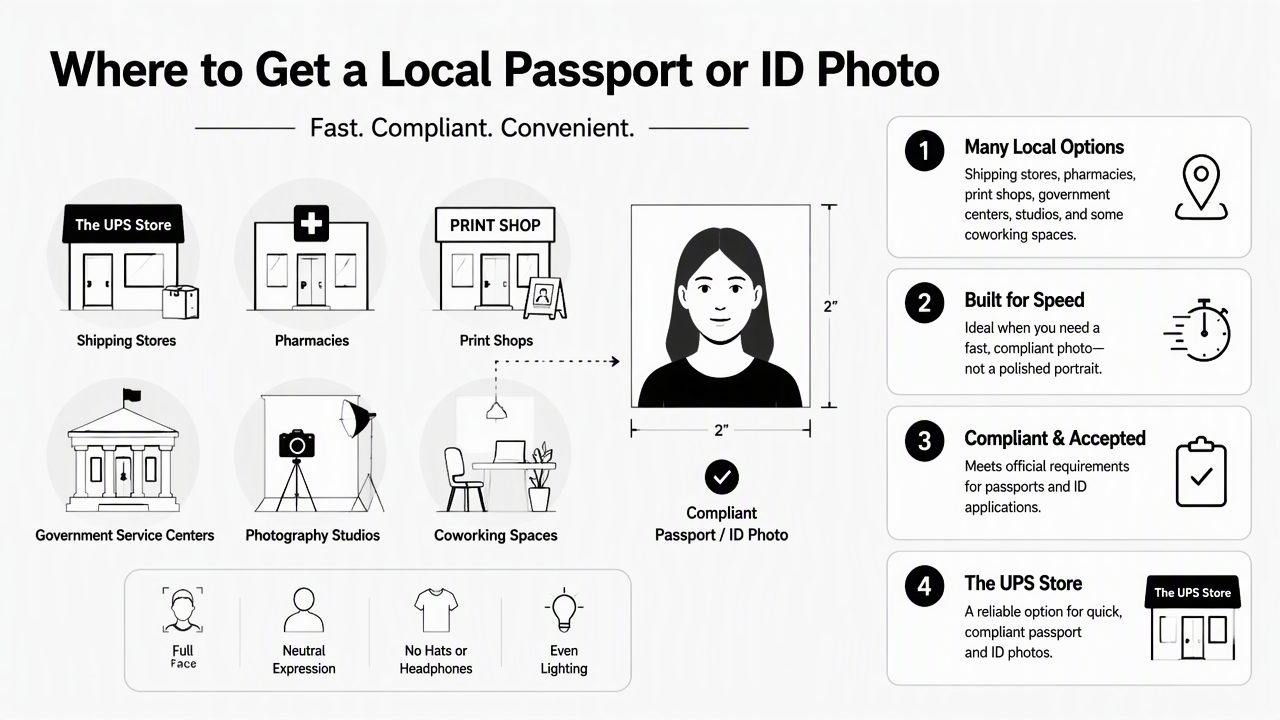
The research data includes The UPS Store as a typical local option, with pages built around passport photos, photo IDs, hours of operation, and frequently asked questions. That structure reflects real search intent: people want a nearby place, clear opening hours, and instructions on what to bring.
Before visiting a local provider, a person should check three practical details:
- Photo purpose: passport, visa, work badge, school ID, or internal HR record.
- Output format: printed copies, digital file, or both.
- Rules: size, background color, glasses policy, head position, and expression.
- Timing: walk-in availability, appointment requirements, and same-day pickup.
- Retake policy: what happens if an authority rejects the image.
Local stores are useful because they remove guesswork. Staff can frame the shot, provide a plain background, and print the right size. The tradeoff is creative control. Lighting may be basic, expression guidance may be rushed, and the result may look more like an ID card than a professional introduction.
What to bring for an in-person photo appointment
A local passport photo visit works best with simple preparation. Bring the application instructions or employer photo rules, because visa, license, badge, and passport requirements can differ. Bring a valid ID if the provider requires it for the service.
Clothing should contrast with the background. A plain dark jacket, collared shirt, blouse, or neat knit usually photographs well. Hats, uniforms, large headphones, and heavy glare from glasses can create problems for compliance photos. For workplace use, overly casual clothing can also send the wrong signal.
Practical rule: dress one level more formal than the workplace profile requires, then keep the expression relaxed.
When does a passport photo help or hurt a work profile?
A passport photo helps when the profile is administrative, regulated, or internal, but it can hurt when the profile must communicate confidence, approachability, or personal brand. The same neutral expression that supports identity verification can feel rigid on LinkedIn, a portfolio, or a company leadership page.
Passport-style images are acceptable for employee directories, internal access systems, HR onboarding portals, regulated credentialing, and some contractor records. In those settings, consistency matters more than character. A plain background and centered face make recognition easier.
Public-facing work profiles need a different standard. Recruiters, clients, partners, and customers often see the photo before reading the biography. A flat ID image can suggest minimal effort, even when the person is skilled. That matters for job seekers, consultants, remote workers, founders, fitness professionals, and creators.
Research on AI and digital governance also makes photo choices more important. Frederik Zuiderveen Borgesius examined discrimination and algorithmic decision-making in a 2025 paper on artificial intelligence and algorithmic decision-making. Patrick Dunleavy and Helen Zerlina Margetts discussed AI and data science in public administration in digital era governance research. These sources are not photo guides, but they show why digital identity, automated screening, and profile presentation deserve care.
Passport photo versus professional profile photo
| Feature | Passport or ID photo | Professional work profile photo |
|---|---|---|
| Main goal | Verify identity | Build trust and credibility |
| Expression | Neutral or lightly natural | Confident, warm, approachable |
| Background | Plain white or light color | Clean office, studio, or brand-fit setting |
| Lighting | Functional | Flattering and balanced |
| Cropping | Strict head size rules | Platform-optimized crop |
| Best channels | Passports, visas, badges | LinkedIn, bio pages, newsletters, proposals |
A job seeker can use an ID-style image in a pinch, but a stronger headshot usually performs better for networking. A founder or freelancer should treat the profile image as brand material, not paperwork. A creator or influencer needs consistency across platforms, so a passport-style crop often feels too limited.
How can a passport-style image be upgraded for LinkedIn and brand profiles?
A passport-style image can be upgraded by improving lighting, expression, crop, background, clothing, and platform fit while keeping the face realistic and recognizable. The goal is not to hide identity; the goal is to present the person in the right professional context.
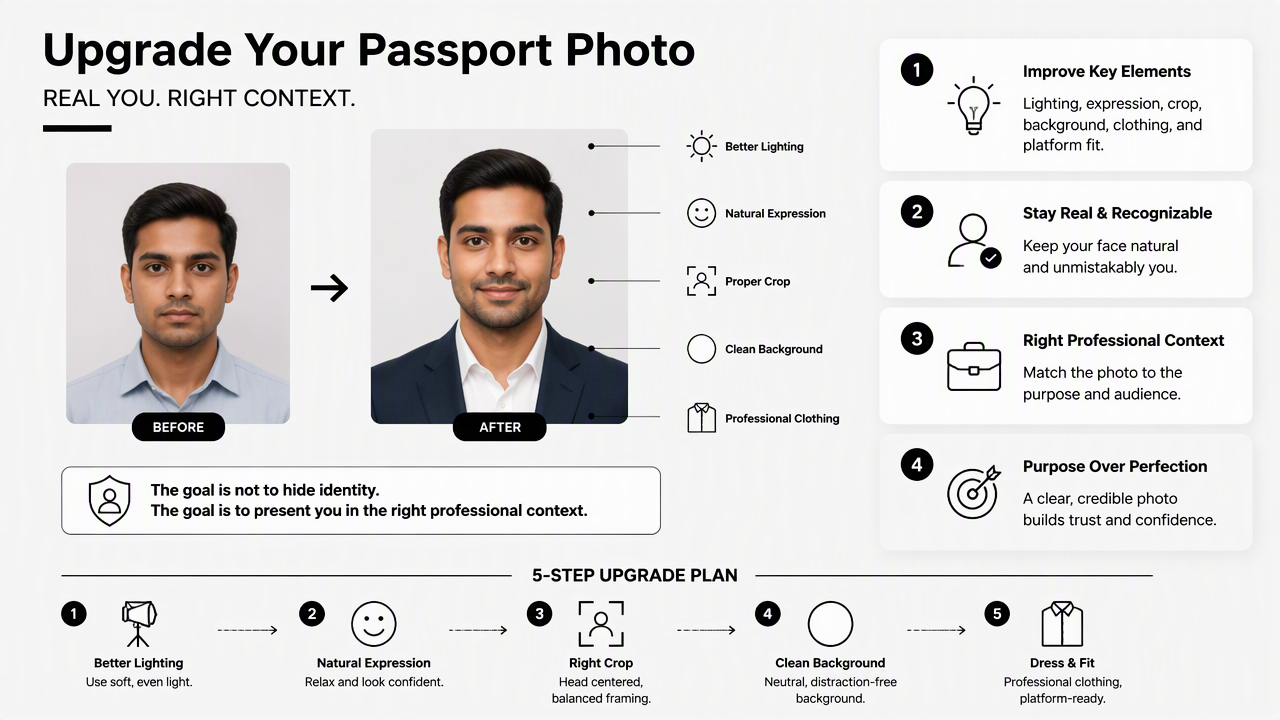
A simple upgrade plan works in five steps:
- Pick the platform first: LinkedIn, company bio, newsletter, marketplace profile, or creator page.
- Choose the right framing: head-and-shoulders for LinkedIn, slightly wider crop for bios.
- Use better lighting: soft front lighting beats overhead office light.
- Keep the background clean: avoid clutter, harsh colors, and distracting objects.
- Match wardrobe to the role: finance, healthcare, fitness, creative, and tech profiles signal differently.
- Export multiple sizes: square, vertical, and banner-friendly versions save time later.
The Looktara platform is useful when a basic ID photo feels too plain for a public-facing career profile. For fitness coaches, trainers, wellness entrepreneurs, and active personal brands, tools such as the fitness LinkedIn profile picture AI generator and fitness LinkedIn product photo AI generator can support a more polished professional presence.
Channel-specific upgrade choices
| Channel | Recommended look | Photo mistake to avoid |
|---|---|---|
| Clear headshot, direct eye contact, soft smile | Cropped passport print with harsh flash | |
| Company bio | Consistent lighting, brand-safe background | Casual selfie in a busy room |
| Newsletter | Warm expression and clean composition | Image too small to read on mobile |
| Instagram business page | Branded, energetic, recognizable | Overly formal ID styling |
| Dating app | Natural and current | Corporate image that feels impersonal |
Work profiles now appear across search results, social feeds, email signatures, and AI-generated summaries. A single photo may be reused many times. That makes the image more valuable than a one-time document snapshot.
For broader visual branding, the fitness Instagram product photo AI generator supports social-first imagery, while the fitness newsletter product photo AI generator fits creators and business owners who publish regularly.
What will work profile photos require in 2027?
Work profile photos in 2027 will likely need to balance authenticity, platform optimization, and AI-aware identity signals. Professional images will still need to look human, but they will also need to work across recruiting platforms, creator pages, internal directories, and automated profile previews.
AI photo tools are already common in app stores and search results. The research data includes AI passport makers that turn selfies into ID-style photos, swap backgrounds, and create formal images. That direction will keep growing. The stronger use case, though, is not just creating a white-background ID image. The bigger need is controlled personal branding.
A practical 2027-ready profile set should include:
- One compliance image for passports, visas, badges, and records.
- One professional headshot for LinkedIn, resumes, and company pages.
- One brand image for websites, newsletters, and media kits.
- One social image for creator, freelance, or dating profiles.
- One plain backup image for platforms with strict upload rules.
Yizhi Wang's 2022 study on NFT news attention and financial markets examined digital attention in a different field, but the broader point is relevant: online attention moves quickly. Profile images are small assets, yet they influence whether a person gets noticed, trusted, or skipped.
The smartest approach is a small image system rather than one all-purpose photo. A nearby passport provider can handle the official image. A studio or AI-assisted platform can create public-facing versions. Looktara fits the second category, especially when the goal is a current, polished work identity. More options are available on looktara.com.
FAQs about passport photos for work profiles
Can a passport photo be used for LinkedIn?
A passport photo can be used for LinkedIn if no better image is available, but it is rarely the strongest choice. LinkedIn benefits from a natural expression, balanced lighting, and a crop that feels professional rather than administrative. A passport image works best as a temporary option.
What should someone wear for a passport or work profile photo?
Simple, well-fitted clothing works best for both passport and work profile photos. Darker tops often contrast well with light backgrounds. For career profiles, clothing should match the target role, such as business casual for corporate roles, clean activewear for fitness brands, or polished casual for creative work.
Are AI passport photo makers good enough for work profiles?
AI passport photo makers can help create clean ID-style images, especially when background and cropping rules are simple. Work profiles need more than compliance, though. A public headshot should look natural, current, and platform-ready. AI-assisted professional photo tools are better suited for that wider goal.
When should a person choose a local store instead of an online tool?
A local store is best for urgent printed passport photos, visa photos, employee badges, and situations with strict document rules. An online or AI-assisted tool is better when the main need is a digital profile image for LinkedIn, a company website, a newsletter, or a creator profile.
Conclusion
The right answer to passport photos close to me for work profiles depends on the job the image must do. Use a local passport or ID photo service for official documents, badges, and strict HR requirements. Use a professional headshot or AI-assisted profile image when the photo must build trust on LinkedIn, a website, a newsletter, or a client-facing profile.
Start with the required format, then create a stronger public-facing version for career and brand channels. For polished work imagery that goes beyond a document photo, visit looktara.com and build a profile set that matches the platform, role, and first impression that matters.
Generated by EarlySEO.com