
TL;DR
Strong Kannada-inspired AI portraits come from specific clothing, setting, lighting, and facial-likeness instructions, not from vague cultural labels. The best results balance Karnataka references, realistic photography language, and respectful styling that avoids costume-like exaggeration.
A strong cultural portrait prompt can turn a regular selfie into a polished Karnataka-inspired profile photo, but a vague prompt can flatten identity into costume. Kannada traditional look AI photo prompts work best when they combine authentic attire, regional context, realistic lighting, and clear likeness instructions. For job seekers, creators, founders, and dating app users, Looktara offers a practical way to create professional AI portraits while keeping the person recognizable.
Table of Contents
What are Kannada traditional look AI photo prompts?
Kannada traditional look AI photo prompts are text instructions that guide an AI image tool to create portraits inspired by Karnataka clothing, festivals, studio photography, and regional aesthetics.
Kannada traditional look AI photo prompt: A written instruction that describes a Karnataka-inspired portrait with details such as saree or dhoti style, jewelry, background, lighting, mood, and facial likeness.
The term Kannada connects to language and culture. The Kannada script is an abugida from the Brahmic family used to write Kannada, a Dravidian language widely associated with Karnataka. Kannadigas refers to Kannada people, primarily native to Karnataka and nearby regions.
Modern image systems respond better to precise instructions because large language and vision models are trained to connect detailed text patterns with output patterns. Research on large-scale language models, such as PaLM by Chowdhery, Narang, Devlin, and coauthors, shows how scale and structured prompts influence model behavior. Prompt clarity matters even more when cultural identity, likeness, and professional use are involved.
Key insight: A good prompt does not just say "Kannada look." It names the outfit, setting, occasion, lighting style, and realism level.
How should a respectful Karnataka-inspired prompt be written?
A respectful Karnataka-inspired prompt should describe real visual elements, avoid stereotypes, and keep the person's face, dignity, and context at the center of the image.
The strongest prompts use cultural specificity without turning identity into a costume. That means describing materials, draping, jewelry, architecture, and occasion in measured language. Words such as "authentic," "elegant," "natural," and "documentary-style" usually work better than exaggerated terms like "royal fantasy" or "mythic warrior" for everyday profile photos.
A simple structure helps the model stay on track:
- Start with the person and purpose: professional headshot, festive portrait, wedding guest look, founder profile, or social media photo.
- Add attire details: Ilkal saree, Mysore silk saree, kurta, dhoti, angavastram, jasmine flowers, or temple jewelry.
- Set the scene: studio backdrop, Bengaluru balcony, heritage courtyard, Mysuru palace-inspired interior, or festival lighting.
- Define photography style: natural skin texture, softbox lighting, 85mm portrait lens, realistic colors, sharp eyes.
- Preserve identity: same face, same age, same facial structure, no face reshaping.
Research on ChatGPT adoption by Menon and Shilpa in Heliyon examined factors that influence user intention to use AI tools. For image prompts, that broader point translates into a practical lesson: trust grows when outputs feel useful, controllable, and aligned with personal goals.
Prompt anatomy for cultural realism
A complete portrait prompt should include five parts, each serving a different job.
- Identity anchor: "Use the uploaded face as the exact reference."
- Clothing anchor: "Mysore silk saree in deep green with gold border."
- Cultural anchor: "Karnataka festive styling with jasmine flowers and subtle gold jewelry."
- Photography anchor: "Realistic studio portrait, soft lighting, natural skin texture."
- Guardrail: "No cartoon effect, no face change, no exaggerated costume styling."
Which prompt templates work best for traditional, festive, and modern looks?
The best prompt templates for Kannada-inspired portraits match the intended use case, because a LinkedIn headshot needs different styling than a wedding, festival, creator, or dating profile image.
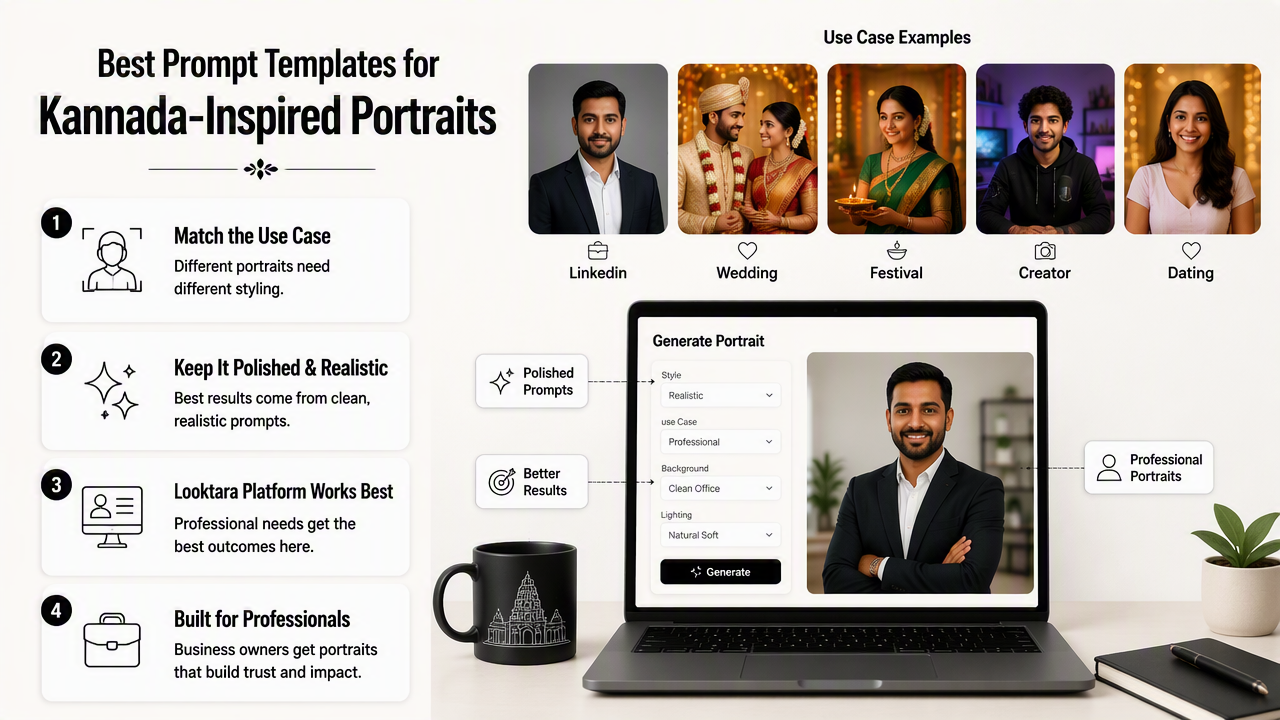
For professional needs, the Looktara platform works best when prompts stay polished and realistic. A business owner might choose a silk saree or kurta with understated jewelry, while a creator may prefer brighter festival colors and a more expressive background. More prompt examples and portrait ideas can be found at looktara.com.
Ready-to-use prompt template table
| Use case | Prompt template | Best for |
|---|---|---|
| Professional profile | "Create a realistic portrait using the uploaded face as the exact reference. Dress the person in a refined Mysore silk saree or cream kurta with subtle Karnataka-inspired details, neutral studio background, soft lighting, natural skin texture, confident expression, sharp eyes, no face change." | LinkedIn, founder pages, resumes |
| Festive portrait | "Create a warm Ugadi or Dasara-inspired portrait with the same face and age. Add elegant traditional attire, jasmine flowers, tasteful gold jewelry, soft festive lights, rich but realistic colors, natural smile, DSLR portrait style." | Instagram, family sharing, creator posts |
| Bridal-inspired look | "Create a graceful South Indian bridal-style portrait with the uploaded face unchanged. Use silk saree, traditional jewelry, flowers, soft bridal makeup, temple or heritage interior, realistic lighting, detailed fabric texture, no fantasy styling." | Wedding concepts, bridal mood boards |
| Men's traditional look | "Create a realistic portrait of the same person wearing a crisp white panche or dhoti with kurta and angavastram, Karnataka festive styling, heritage courtyard background, natural expression, studio-quality light, no face alteration." | Festivals, professional culture posts |
| Modern cultural profile | "Create a modern portrait with the same face wearing a contemporary kurta, saree, or Indo-western outfit with subtle Kannada cultural styling, clean urban background, soft daylight, premium editorial look, realistic skin." | Dating apps, creator bios, personal branding |
Short prompts for quick edits
Short prompts are useful when a tool already has a strong reference photo and only needs styling direction.
- "Same face, elegant Karnataka festive portrait, Mysore silk saree, jasmine hair styling, soft studio light, realistic skin, no face change."
- "Same person, traditional Kannada men's outfit with dhoti, kurta, angavastram, heritage courtyard, natural expression, DSLR realism."
- "Professional headshot with subtle Karnataka cultural styling, refined saree or kurta, neutral background, soft light, authentic face likeness."
- "Modern South Indian cultural profile photo, same facial features, tasteful jewelry, warm colors, natural smile, realistic portrait."
Better prompts sound like photography directions, not costume orders.
How can facial likeness be preserved in AI portraits?
Facial likeness can be preserved by using a clear reference photo, repeating identity instructions, and limiting edits to clothing, lighting, pose, and background.
Most failed cultural portraits happen when the model changes too much at once. A prompt that asks for a new outfit, new pose, new face angle, heavy makeup, cinematic lighting, and fantasy background may drift away from the original person. A safer prompt keeps the face stable and changes the styling around it.
Use direct likeness language:
- "Keep the exact same face, age, skin tone, and facial structure."
- "Do not change eyes, nose, lips, jawline, or face shape."
- "Only change outfit, background, lighting, and styling."
- "Maintain realistic skin texture and natural expression."
- "Avoid beauty filter, plastic skin, or celebrity resemblance."
The BIG-Bench chain-of-thought study by Süzgün and coauthors focused on complex reasoning tasks, not portrait editing. Still, it supports a broader prompt-writing idea: multi-step instructions can help AI systems handle complex requests more predictably.
A practical prompt can say: "Use the uploaded image as the identity reference. Keep the same face and age. Create a traditional Karnataka-inspired portrait with a silk saree, jasmine flowers, warm studio lighting, and realistic photography. Do not alter facial features."
How can AI portraits avoid looking like costumes?
AI portraits avoid a costume-like look when prompts use real clothing references, restrained styling, natural poses, and context that fits the person's intended use.
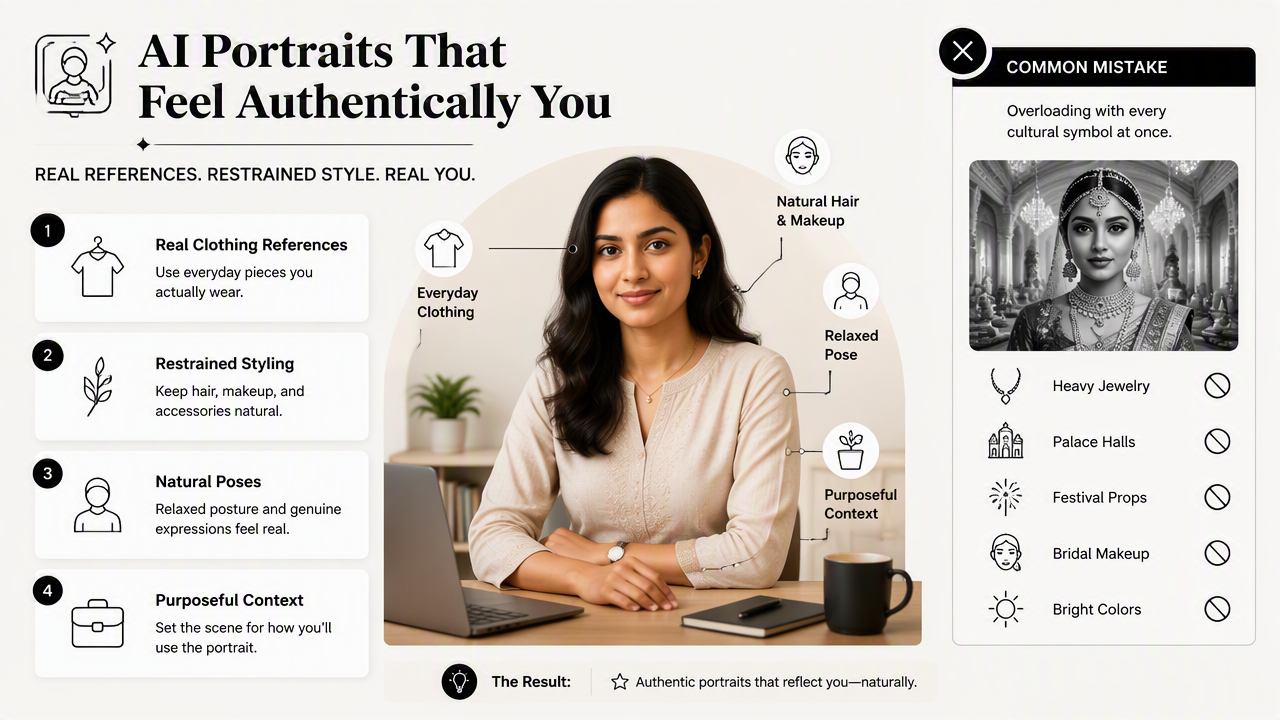
The common mistake is overloading the image with every cultural symbol at once. Heavy jewelry, dramatic palace halls, festival props, bridal makeup, bright filters, and unrealistic fabric can make a profile photo feel staged. Better portraits choose one strong cultural anchor and keep the rest simple.
A respectful prompt should avoid:
- Generic phrases such as "Indian princess," "exotic traditional woman," or "ancient warrior."
- Mixing unrelated regional styles without a clear reason.
- Over-bright skin smoothing or major facial reshaping.
- Sacred or ceremonial symbols used as decoration without context.
- Festival styling that clashes with a corporate or dating profile goal.
Safer alternatives include "Karnataka-inspired festive styling," "Mysore silk saree with natural studio lighting," or "elegant Kannada cultural portrait for a professional profile." These phrases signal respect while still giving the model enough visual direction.
Looktara is especially relevant for users who need cultural portraits that still work as real profile photos. With Looktara, the goal can stay practical: a clear face, tasteful styling, and images that feel suitable for LinkedIn, founder profiles, social platforms, or personal branding.
What should change in 2026 and beyond?
AI portrait prompting in 2026 is moving toward more identity control, better regional detail, and clearer consent around face-based image generation.
Models are getting better at following fine-grained instructions, but prompt writers still need to be precise. Regional Indian portrait prompts will likely become more specific, with users asking for Ilkal saree borders, Mysuru silk textures, Bengaluru urban backdrops, coastal Karnataka jewelry, or North Karnataka festive styling instead of broad "South Indian" labels.
Professional use will also become more practical. Job seekers may need one culturally rooted headshot and one neutral corporate version. Entrepreneurs may need matching portraits for LinkedIn, pitch decks, press kits, and social channels. Creators may need festive images that match a content calendar without looking artificial.
A smart 2026 workflow looks like this:
- Pick the final platform first: LinkedIn, Instagram, dating app, website, or resume.
- Choose one cultural theme: festive, bridal-inspired, traditional professional, or modern Kannada look.
- Upload a clear face reference with natural lighting.
- Use one complete prompt, then refine only one variable at a time.
- Save the best prompt version for future profile updates.
For polished profile-ready images, with Looktara can be part of that workflow when a realistic headshot matters more than a fantasy edit. For direct access, head to looktara.com after choosing the prompt style and intended use.
FAQ about Kannada-inspired AI portrait prompts
Kannada-inspired AI portrait prompts work best when they balance cultural detail, realism, and clear identity protection.
Can a Kannada traditional look prompt be used for LinkedIn?
Yes, a Kannada-inspired prompt can work for LinkedIn when the styling stays refined and professional. A neutral studio background, subtle jewelry, clean saree or kurta, and confident expression are better than heavy festival props. The prompt should prioritize facial clarity, realistic lighting, and a polished profile-photo composition.
Which outfit details make prompts more authentic?
Specific outfit details help more than broad labels. Prompts can mention Mysore silk saree, Ilkal-style border, jasmine flowers, simple gold jewelry, kurta, panche, dhoti, or angavastram. The best choice depends on the occasion and the person's intended image, not on adding every possible traditional element.
How many reference photos are needed for a good result?
One clear reference photo can be enough if the face is well lit, sharp, and front-facing. Multiple images may improve consistency when the tool supports them. The prompt should still state that the same face, age, skin tone, and facial structure must be preserved across all outputs.
Are Kannada and South Indian prompts the same?
No, Kannada and South Indian prompts are not the same. "South Indian" is a broader label, while Kannada-inspired prompts can focus on Karnataka-specific attire, locations, festivals, and styling. More specific wording usually creates portraits that feel less generic and more connected to the intended cultural reference.
Conclusion
Kannada traditional look AI photo prompts are most effective when they treat culture as context, not decoration. The best next step is simple: choose a use case, select one Karnataka-inspired style, add strict facial-likeness instructions, and test a realistic photography prompt before making creative variations. For professional headshots, creator images, or modern cultural profile photos, Looktara can help turn those prompts into polished portraits ready for real profiles.
Generated by EarlySEO.com