
TL;DR
Custom photo products work best when they make a business easier to recognize, trust, and remember. Entrepreneurs should prioritize profile images, business cards, media kits, landing pages, thank-you cards, and event signage before spending on novelty gifts or low-use merch.
A strong founder photo can turn a business card, pitch deck, product insert, or landing page from generic to credible in seconds. Custom photo products for entrepreneurs are no longer just mugs and calendars; in 2026, they support hiring, sales, creator growth, and personal branding across print and digital channels. The strongest starting point is a consistent image library, and Looktara helps entrepreneurs create polished visual assets before sending files to printers, marketplaces, and web builders.
Table of Contents
What are custom photo products for entrepreneurs?
Custom photo products for entrepreneurs are branded print, digital, and merchandise items that use a founder photo, product photo, lifestyle image, or creator portrait to support trust, recall, and sales. The best products solve a business goal, such as credibility on LinkedIn, stronger event presence, better media outreach, or more memorable customer follow-up.
Custom photo product: a physical or digital item personalized with a business image, usually a headshot, product photo, brand scene, customer image, or campaign visual.
Retail SERPs still lean heavily toward photo gifts, with major pages from Walgreens Photo, Artifact Uprising, Nations Photo Lab, Mpix, and other labs focused on mugs, blankets, puzzles, wall art, cards, books, and prints. That gift-first framing misses the practical entrepreneur use case: brand proof.
The most useful photo product is not the one with the biggest print area; it is the one that appears at the moment a buyer, partner, journalist, or follower decides whether the business feels real.
Research on generative AI in work settings, including Budhwar, Chowdhury, and Wood's 2023 paper on ChatGPT and human resource management, shows how AI tools are becoming part of professional decision-making and workplace communication (Human Resource Management Journal). For entrepreneurs, that makes visual consistency more important because brand assets travel across profiles, PDFs, inboxes, and AI-assisted search surfaces.
Which photo products build the most trust?
The photo products that build the most trust are the ones tied to discovery, proof, purchase, and follow-up. Business cards, media kits, landing pages, thank-you cards, event signage, and packaging inserts usually outperform novelty gifts because they appear during real commercial interactions.
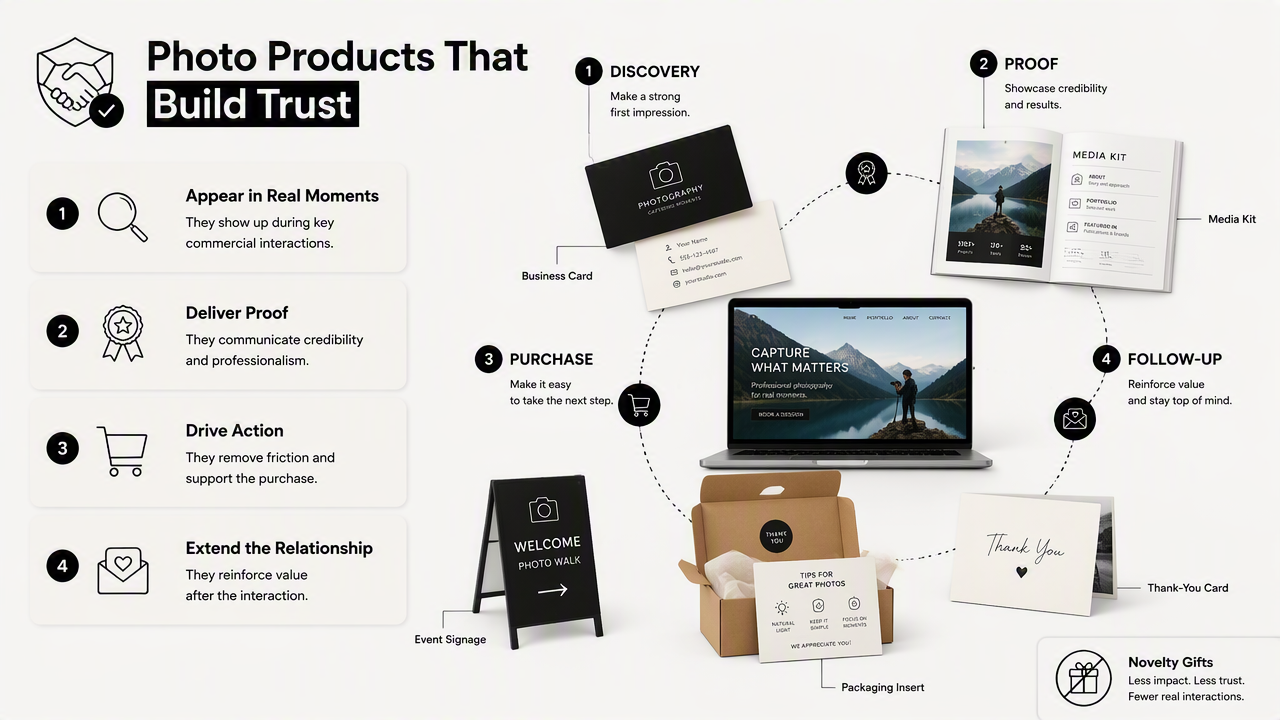
Trust-building product priorities
| Product | Best use | Image type | Priority |
|---|---|---|---|
| Business cards | Networking, events, local sales | Founder headshot or branded product image | High |
| Media kit | Press, podcast pitches, sponsor outreach | Headshot, logo, product photos | High |
| Landing page hero | Ads, launches, newsletters | Founder or product lifestyle image | High |
| Thank-you card | Customer retention, referrals | Warm founder photo or product scene | Medium-high |
| Event signage | Booths, workshops, pop-ups | Large portrait, offer image, QR visual | Medium-high |
| Creator merch | Community building, paid fan products | Campaign image or signature visual | Medium |
| Photo mugs and puzzles | Gifts, light-touch brand moments | Casual brand image | Low for most businesses |
A founder selling coaching, consulting, design, real estate, fitness programs, handmade goods, or creator subscriptions needs visual proof before decorative goods. A LinkedIn banner, press one-sheet, and sales page image usually create more business value than a custom blanket.
Several print labs promote same-day pickup, ship-to-store, and ship-to-home options, including Walgreens Photo's same-day and shipping categories in its photo product navigation. Those services matter most for entrepreneurs preparing for trade shows, pop-ups, conferences, speaking events, or last-minute client gifts.
For fitness entrepreneurs, creator-led brands, and service providers, channel-specific visuals reduce friction. A trainer updating a professional profile can prepare a polished image set with a fitness LinkedIn product photo generator, while a product-based creator can test campaign visuals before ordering prints or packaging inserts.
How should entrepreneurs choose photo gifts and print items?
Entrepreneurs should choose photo gifts and print items by matching each product to a business occasion, audience, and measurable next action. A product is worth ordering when it supports trust, repeat purchase, referral, event recognition, or press readiness, not just because it is customizable.
A simple buying framework
- Define the occasion: launch, event, client onboarding, holiday gifting, sponsor pitch, or creator drop.
- Pick the audience: buyers, press, partners, subscribers, employees, or event guests.
- Choose the image role: headshot for trust, product image for clarity, lifestyle photo for aspiration.
- Select the format: digital first for speed, print for memory, merch for community.
- Check distribution: same-day pickup, ship-to-home, ship-to-store, or direct fulfillment.
- Order a small test batch: review color, cropping, paper quality, and scan codes before scaling.
Photo gifts work well when the recipient already has an emotional connection to the business. A wedding photographer may send clients a small print set. A coach may mail thank-you cards after a high-ticket program. A local bakery may include a founder note with catering orders.
Novelty products become wasteful when they lack a clear role. Branded puzzles, blankets, playing cards, and coasters can fit a creator community or holiday campaign, but they rarely belong in the first spending round for a new consultant or freelancer.
Specialty prints, posters, acrylic blocks, cards, and invitations deserve more attention than generic gift items. Posters can support workshops and pop-up booths. Specialty prints can make premium offers feel tangible. Cards can turn a one-time order into a repeat purchase moment.
A creator planning a newsletter launch can prepare consistent product visuals for email using a fitness newsletter product photo generator. A visual-first brand can also test Pinterest concepts with a fitness Pinterest product photo generator before spending on printed campaign pieces.
How Looktara handles entrepreneur brand imagery
The Looktara platform helps entrepreneurs create consistent, polished photo assets that can be used across digital profiles, product pages, media kits, print materials, and social campaigns. That matters because custom products only look professional when the source image has the right framing, lighting, crop, and brand fit.
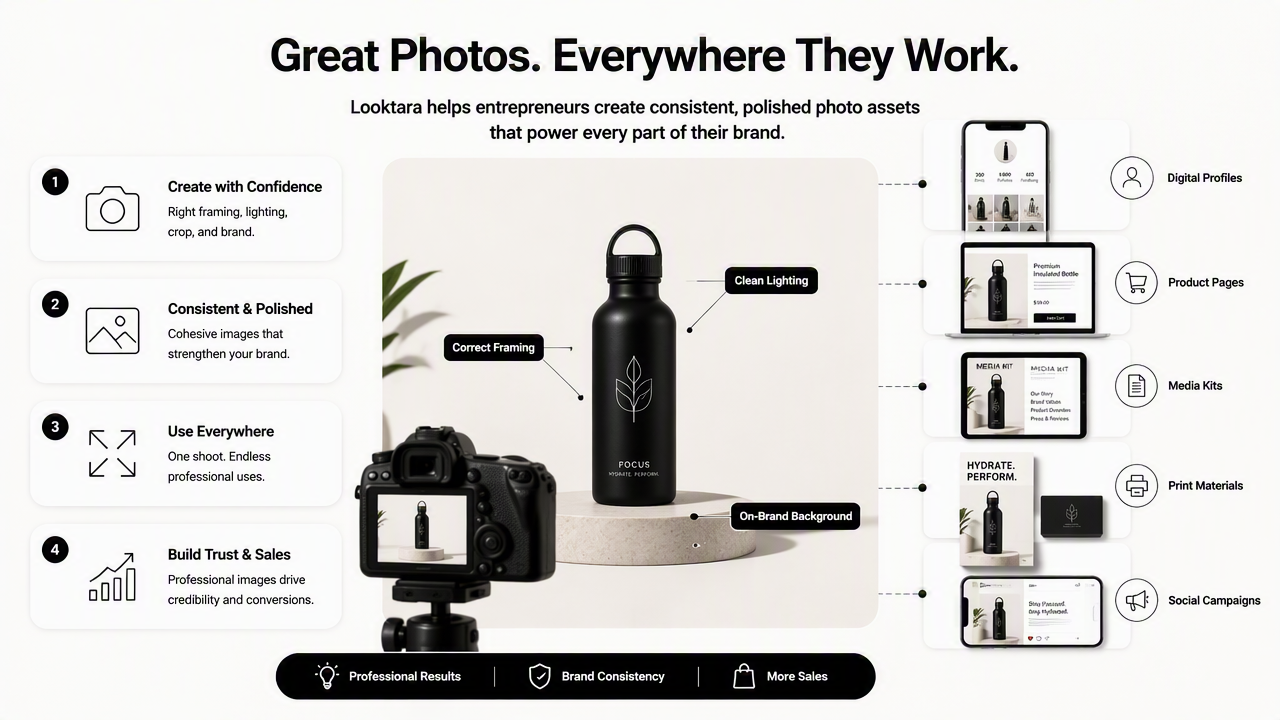
Where polished source images matter most
- Business cards: a clean headshot can make a solo business feel more personal and credible.
- Media kits: consistent portraits and product visuals help journalists, sponsors, and podcast hosts use the right assets.
- Landing pages: a clear founder or product image can support trust near a call-to-action.
- Event signage: high-resolution images reduce blur and awkward cropping on posters and banners.
- Thank-you cards: warm, human images can make post-purchase communication feel less automated.
- Merch mockups: campaign visuals can be checked before a paid production run.
A strong image system also helps entrepreneurs avoid scattered branding. Profile photos, pitch visuals, newsletter headers, and print pieces should look like they came from the same business, even when different vendors print or host them.
For product-led fitness brands, mockups can make campaign planning faster. A founder can preview Instagram creative through a fitness Instagram product mockup AI generator, then adapt the same visual direction for event cards, landing pages, or creator merch.
Looktara fits best before the printing stage. Image generation and mockup planning help entrepreneurs decide what belongs on a card, sign, PDF, or product page before paying for rush printing, shipping, or bulk inventory.
What will matter for photo products in 2026 and 2027?
Photo products in 2026 and 2027 will become more connected, faster to produce, and more personalized across channels. Entrepreneurs should expect more AI-assisted image creation, smaller print runs, QR-connected materials, and product mockups that test demand before physical inventory gets ordered.
Digital and physical branding are merging. A thank-you card may link to a personalized landing page. A poster may send visitors to a booking form. A media kit may include downloadable headshots, product photos, founder bios, and short-form video stills.
Research by Torous, Bucci, and Bell in 2021 examined apps, social media, chatbots, and virtual reality as part of the expanding digital tool field (World Psychiatry). Although focused on digital psychiatry, the paper reflects a broader shift: more personal and professional experiences now pass through app-based and virtual interfaces.
Haleem, Javaid, and Singh's 2022 work on Medical 4.0 technologies also describes connected digital capabilities across systems and applications (Internet of Things and Cyber-Physical Systems). For entrepreneurs, the takeaway is practical: printed materials should no longer stand alone when a QR code, short URL, or campaign page can connect offline interest to online action.
Products likely to gain value
- QR-enabled business cards for booking pages, portfolios, and product demos.
- Modular media kits with matching photos for press, sponsors, and podcasts.
- Short-run event signage for pop-ups, markets, and workshops.
- Personalized customer cards for premium orders and client milestones.
- Creator merch mockups that validate demand before production.
A fitness brand preparing LinkedIn launch visuals can use a fitness LinkedIn product mockup generator to test presentation style before committing to printed sales collateral. For direct-response campaigns, a fitness newsletter product mockup generator can help align email visuals with inserts, cards, or launch graphics.
The next practical edge will be speed with quality control. Same-day pickup helps solve urgent event needs, while ship-to-home and ship-to-store support planned campaigns. The better habit is to keep ready-to-print headshots, product images, and brand scenes available before a deadline appears.
Frequently asked questions
Entrepreneurs usually need clear rules for which custom photo products deserve money, time, and storage space. The answers below focus on business value rather than novelty.
What is the best first custom photo product for a new entrepreneur?
The best first product is usually a polished headshot or founder image adapted for LinkedIn, a landing page, and a media kit. After that, business cards and thank-you cards make sense for in-person networking, customer follow-up, or local sales. Physical products should follow a clear distribution plan.
Are photo gifts useful for business branding?
Photo gifts are useful when they strengthen an existing customer, client, or community relationship. They work better as thank-you items, milestone gifts, premium client touches, or creator fan products than as broad awareness tools. For most entrepreneurs, cards, prints, and signage come before mugs or blankets.
When should same-day pickup be used?
Same-day pickup is best for events, speaking engagements, pop-up shops, last-minute client meetings, and urgent replacement prints. It should not replace normal proofing for important brand materials. A small test order still helps catch cropping, color, paper, and QR-code problems before public use.
What image quality is needed for posters and signage?
Posters and signage need high-resolution images with clean lighting, clear subject focus, and enough empty space for text or QR codes. A photo that looks fine on a phone may look soft or crowded when enlarged. Event materials should be checked at actual size before printing.
How many branded photo products are enough?
Most entrepreneurs need a small core set: profile photo, business card, media kit, landing page image, thank-you card, and one event or merch format when relevant. More products only make sense when a campaign, launch, or audience habit gives each item a clear job.
Conclusion
Custom photo products for entrepreneurs work best as trust tools, not random merchandise. The practical next step is to build a small image library, choose one business occasion, and order only the products that support a real interaction: a meeting, pitch, purchase, event, or follow-up.
Start with a polished headshot, product image, or brand scene, then adapt it for cards, media kits, landing pages, signage, and customer notes. For entrepreneurs ready to prepare image assets before printing or publishing, Looktara provides a focused place to create professional visuals. Visit looktara.com, build a reusable image set, and turn the strongest photos into products that earn attention instead of collecting dust.
Generated by EarlySEO.com