
TL;DR
AI portraits work best when creators turn them into focused brand assets, not random merch. Media cards, thank-you inserts, stickers, posters, and digital downloads each need different resolution, file, and taste checks before printing or selling.
Custom photo products for creators using AI portraits are becoming a practical brand system, not just a novelty gift category. A single strong portrait can become a media kit image, thank-you card, sticker sheet, poster, newsletter graphic, or paid digital download when the file is prepared correctly. AI art: artistic content generated or assisted by artificial intelligence programs, with ongoing debate about how the output should be classified as art. For creators, the useful question is less about labels and more about trust, taste, and repeatable quality. Looktara helps turn polished portrait imagery into creator-ready visuals that can support professional profiles, launches, and content channels without a studio shoot.
Table of Contents
What are custom photo products for creators using AI portraits?
Custom photo products for creators using AI portraits are physical or digital brand items made from AI-assisted likeness images, such as cards, stickers, posters, mockups, inserts, and downloads. The strongest products keep the creator recognizable, match the channel where the item appears, and avoid over-stylized effects that weaken credibility.
Creator portrait product: a branded asset that uses a person's likeness as the main visual element across print, packaging, social, or downloadable formats.
AI portraits sit between personal branding and product design. Wikipedia's definition of AI art frames the work as generated or assisted by artificial intelligence, while also noting that its classification remains debated. That matters because creator products are judged by audiences, buyers, collaborators, and platforms, not only by the software used to make them.
A good AI portrait product should make a creator easier to recognize, remember, and trust.
The best use cases are practical. A fitness coach might use a bold portrait on an Instagram launch graphic, then carry the same look into a printed thank-you insert. A consultant might use a polished headshot style on LinkedIn and a softer version for a newsletter header. For channel-specific portrait assets, creators in fitness and coaching can use an Instagram product photo generator or a LinkedIn product photo generator to keep the visual system consistent.
Which AI portrait products fit a credible creator brand?
Credible AI portrait products connect a recognizable face to a clear audience action, such as following, booking, buying, saving, or sharing. The strongest product choice depends on where the audience meets the creator and how much visual polish that channel expects.
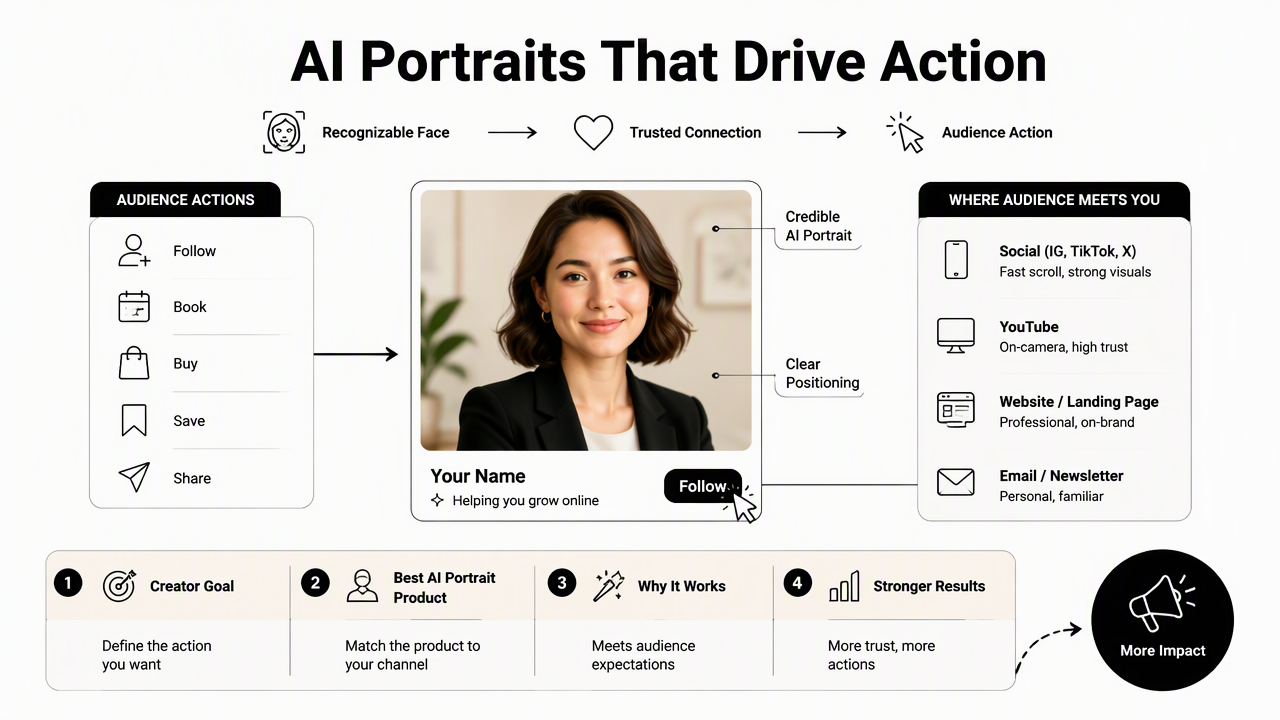
Best product formats by creator goal
| Creator goal | Best AI portrait product | Why it works | File priority |
|---|---|---|---|
| Book brand deals | Media card or one-sheet | Shows identity, niche, and contact details fast | Sharp face detail, clean background |
| Increase repeat purchases | Thank-you insert | Adds a human touch inside packaging | Print-safe margins, readable type |
| Build community | Sticker sheet | Turns a likeness into a shareable symbol | Simple shapes, high contrast |
| Sell fan items | Poster or mini print | Gives the portrait collectible value | High resolution, low noise |
| Grow email list | Digital wallpaper or download | Trades a visual asset for signup intent | Multiple aspect ratios |
| Launch content series | Social mockup set | Keeps posts visually tied together | Platform-specific crops |
Media cards work well for creators who pitch brands, podcasts, events, or press. The portrait should support authority, not dominate the entire design. A creator with a clear niche, such as fitness, wellness, finance, food, or beauty, benefits from a layout that pairs the face with proof points, audience details, and a short positioning line.
Thank-you inserts and packing cards are better for small shops, coaches, and digital sellers. These products make an order feel personal without requiring a handwritten note every time. A newsletter-first creator can pair portrait imagery with a printable insert or a header made through a newsletter product photo generator.
Stickers and posters need more restraint. Highly detailed AI faces often look strange at small sticker sizes, while poster prints expose every artifact. The safest approach is to simplify the image, remove busy backgrounds, and keep one expressive pose per product.
How should AI portrait files be prepared for print and digital products?
AI portrait files should be prepared by matching resolution, crop, color, and export format to the final product before any printing or selling step. A portrait that looks crisp on a phone can still fail on a poster, sticker sheet, or media card if the pixel dimensions are too low.
Resolution and export guide
| Product | Practical minimum size | Recommended format | Key check |
|---|---|---|---|
| Media card, 5 x 7 in | 1500 x 2100 px | PDF or PNG | Text remains sharp |
| Thank-you insert, 4 x 6 in | 1200 x 1800 px | Safe margin around edges | |
| Sticker, 3 in | 900 x 900 px | PNG with transparent background | Clean outline and contrast |
| Poster, 12 x 18 in | 3600 x 5400 px | TIFF, PNG, or print PDF | Face detail holds up close |
| Digital wallpaper | Device-specific sizes | PNG or JPG | No awkward crop on face |
| Pinterest pin | Tall vertical crop | PNG or JPG | Readable at small preview size |
A 300 PPI target remains the safest planning rule for most small print products. Large wall prints can sometimes work at lower effective resolution because they are viewed from farther away, but creator merchandise usually benefits from sharper files because buyers inspect faces closely.
For digital channels, dimensions matter more than print density. Pinterest favors vertical visuals, newsletters need lighter files that load quickly, and LinkedIn visuals need a professional crop that does not feel like a fantasy avatar. Creators planning evergreen boards can adapt portraits with a Pinterest product photo generator.
Research on digital light processing by Xinhui Wang, Jinghang Liu, and Yang Zhang in Virtual and Physical Prototyping examined advances in precision microfabrication and materials for digital production methods, underscoring a wider trend: digital files increasingly shape physical outputs source. For creators, that makes pre-print file review part of brand quality, not a technical afterthought.
Preflight checklist before ordering samples
A creator should check the file at actual size before ordering samples, because AI artifacts often hide in previews.
- Open the file at 100 percent zoom.
- Check both eyes, teeth, fingers, hairlines, and jewelry.
- Confirm the face still looks like the creator.
- Test the crop on the exact product shape.
- Leave safe margins for trimming.
- Export one master file and one product-specific file.
- Order one sample before selling in public.
Common weak points include waxy skin, mismatched earrings, melted text, extra fingers, and backgrounds that feel too fake. These problems are easier to fix before layout than after a print-on-demand order has been placed.
What taste-level checklist keeps AI portraits on-brand?
A taste-level checklist keeps AI portraits believable, recognizable, and commercially useful by filtering out images that look flashy but not trustworthy. For creator brands, taste is the difference between a portrait that builds authority and one that feels like disposable AI art.
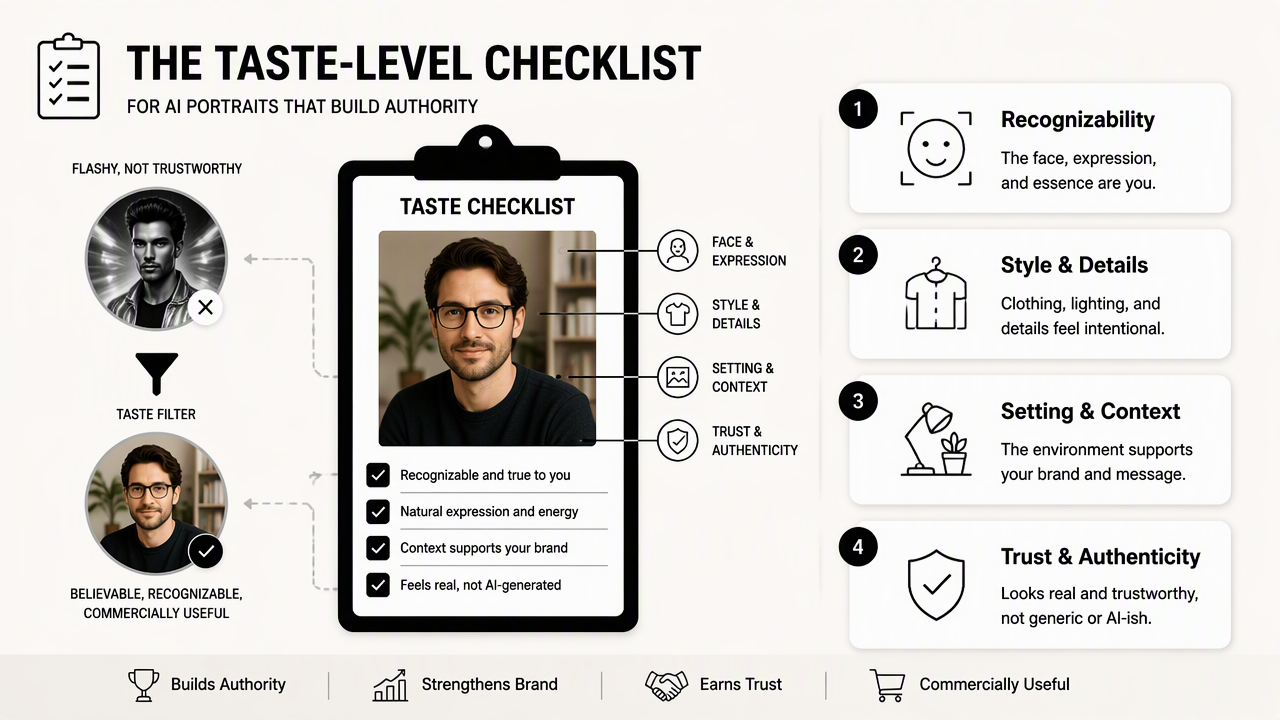
Brand-fit filters for creator products
- Recognizability: the face, expression, and overall presence still match the real person.
- Context: the outfit, props, and background fit the niche and audience.
- Restraint: effects support the message instead of showing off the tool.
- Legibility: type, logos, QR codes, and calls to action remain easy to read.
- Consistency: the same lighting, color palette, and mood can repeat across products.
- Permission: collaborators, clients, and recognizable third parties are not included without approval.
The strongest creator products rarely use the wildest image in a batch. They use the image that feels most ownable. A fitness creator might choose strong daylight, clean athletic styling, and confident posture over glowing fantasy effects. A coach or consultant might choose editorial warmth over heavy retouching.
A 2022 study by Dean A. Shepherd and Trenton Alma Williams in Small Business Economics examined different response paths to organizational resilience source. While the study is not about portraits, its small-business focus fits the creator reality: resilient brands need adaptable systems. A reusable portrait style can support launches, pitches, and customer touchpoints without rebuilding the visual identity each week.
Tasteful AI portrait products look intentional even when the production process is fast.
How the Looktara platform handles creator portrait assets
The Looktara platform is useful when creators need portrait-led visuals that feel channel-aware rather than generic. Instead of treating one image as a universal asset, the workflow can support different crops, contexts, and product mockups for social posts, professional profiles, and branded promotions.
For example, a creator preparing a course launch might build a professional profile image, a mockup for Instagram, and a product-style visual for a newsletter. Fitness creators testing promotional layouts can use an Instagram product mockup generator for social previews and a newsletter product mockup generator for email-first visuals.
Mixed reality research by Julián de la Fuente Prieto, Pilar Lacasa, and Rut Martínez Borda explored youth media platforms and mixed reality interfaces source. That broader shift matters for 2026 creator branding because audiences now move between profile photos, short-form video, digital goods, and physical merchandise. Portrait systems need to travel across those surfaces without losing identity.
What should creators expect from AI portrait products in 2027?
AI portrait products in 2027 will likely become more personalized, more format-specific, and more connected to creator commerce workflows. The biggest change will not be more dramatic image styles; it will be better translation from one approved likeness into many credible product formats.
Print-on-demand, digital downloads, and social commerce already reward fast testing. The next phase should favor creators who build a controlled portrait library with approved poses, backgrounds, crops, and brand colors. That library can feed media cards, launch graphics, packaging inserts, wallpapers, sticker concepts, and campaign visuals with less guesswork.
2027-ready creator asset plan
- Build a small set of approved portrait styles instead of endless one-off images.
- Keep separate files for print, social, newsletter, and marketplace use.
- Document color codes, fonts, prompts, and editing rules.
- Save original source images and final exported files.
- Review platform rules before selling AI-assisted downloads or merch.
Creators who sell digital files should pay close attention to trust signals. Product descriptions should state what the buyer receives, such as file size, format, and intended use. Physical products should be sampled before launch, especially posters, stickers, and inserts where small defects can look unprofessional.
FAQ
AI portrait products are most successful when creators treat them like brand assets with quality control, not quick experiments. The questions below cover practical decisions that affect trust, print quality, and product fit.
Can AI portraits be used for professional creator products?
AI portraits can be used for professional creator products when the likeness is accurate, the style fits the brand, and the final file meets print or platform requirements. Media cards, inserts, mockups, and digital downloads are usually safer starting points than large posters because they allow smaller tests before broader selling.
What file type works best for AI portrait printing?
PDF is often best for layouts with text, while PNG works well for transparent stickers, social graphics, and digital downloads. TIFF or high-quality PNG can suit posters when the image is large enough. The file type matters less than resolution, crop, clean edges, and a careful review at actual size.
Are AI portrait stickers a good creator merch idea?
AI portrait stickers can work well when the design is simple, recognizable, and tied to a community phrase, pose, or visual identity. Tiny facial details often print poorly, so sticker designs need stronger outlines, fewer background elements, and high contrast. A sample sheet should be checked before public sales.
How many portrait styles should a creator use?
Most creators need two to four portrait styles: one professional, one social, one promotional, and possibly one playful community style. Too many styles can make the brand feel scattered. A small style library makes it easier to build consistent media cards, inserts, digital products, and campaign graphics.
Conclusion
Custom photo products for creators using AI portraits work best when the portrait is recognizable, the product has a clear job, and the file is prepared for its final format. The smart next step is to choose one high-value product, such as a media card, thank-you insert, sticker sheet, or digital download, then test it with one approved portrait style before scaling.
For creators ready to turn polished portraits into branded assets, Looktara can support the visual production process across profile, product, and campaign formats. Visit looktara.com, choose the first product category, prepare the file checklist, and order or publish a small test before building a larger creator product line.
Generated by EarlySEO.com