
TL;DR
The strongest profile photo changes by platform: LinkedIn rewards polish and credibility, Slack rewards recognizability and warmth, and dating apps reward authenticity plus visual variety. A single photo can work across profiles only when it is clear, current, well-lit, and adjusted for each platform's trust signals.
A profile photo is no longer just a face crop; it is a trust signal that works differently on LinkedIn, Slack, dating apps, and creator profiles. The best profile pictures for LinkedIn Slack and dating apps balance clarity, expression, background, and context instead of using the same polished headshot everywhere. Profile picture: a profile picture is a public-facing image, or computing avatar, that represents a person's identity, role, or persona across digital platforms. For people who need fast, polished options, Looktara helps create professional profile imagery suited to business and social use cases.
Table of Contents
What makes the best profile pictures for LinkedIn Slack and dating apps?
The best profile pictures for LinkedIn Slack and dating apps match the platform's expected trust signal: LinkedIn favors competence, Slack favors approachability, and dating apps favor authenticity. The same face can work across all three, but the crop, styling, expression, and background should not be identical.
Research on real-time social media use, such as Ludmila Lupinacci's 2022 work on "real-time" social media experiences in New Media & Society, supports a simple idea: people judge digital presence quickly and in context. A polished photo can help on LinkedIn, but the same level of polish may look too formal on a dating profile.
Key insight: a strong profile photo is not universally "professional"; it is context-aware.
Instant messaging platforms also create different expectations. Instant messaging is real-time computer-mediated communication, so Slack avatars must remain recognizable at small sizes during fast workplace exchanges. Dating apps, by contrast, need more than identification; they need personality, lifestyle cues, and a sense of comfort.
Platform photo requirements at a glance
| Platform | Best expression | Crop | Background | Outfit | Level of polish |
|---|---|---|---|---|---|
| Calm, confident smile | Head and shoulders | Clean office, neutral wall, subtle brand setting | Industry-appropriate, structured | High | |
| Slack | Friendly, relaxed | Close head crop | Simple, uncluttered | Casual-professional | Medium |
| Dating apps | Warm, natural, expressive | Mix of headshot, half-body, full-body | Real-life settings, outdoor light, social context | Personal style, flattering fit | Medium-low |
| Creator profiles | Energetic, on-brand | Face-forward or signature pose | Brand colors, studio, niche setting | Recognizable visual identity | Medium-high |
| Remote work profiles | Clear, steady, approachable | Head and shoulders | Bright home office or neutral space | Polished but not stiff | Medium |
The table shows why copying a LinkedIn headshot into a dating profile often feels off. LinkedIn asks, "Is this person credible?" Slack asks, "Can coworkers recognize this person quickly?" Dating apps ask, "Does this person seem real, attractive, and comfortable to meet?"
How should a LinkedIn profile photo look in 2026?
A LinkedIn profile photo should look current, clear, and credible, with the face taking visual priority and the background supporting the professional identity. The strongest images feel polished without looking overedited, especially for job seekers, founders, consultants, coaches, and remote professionals.
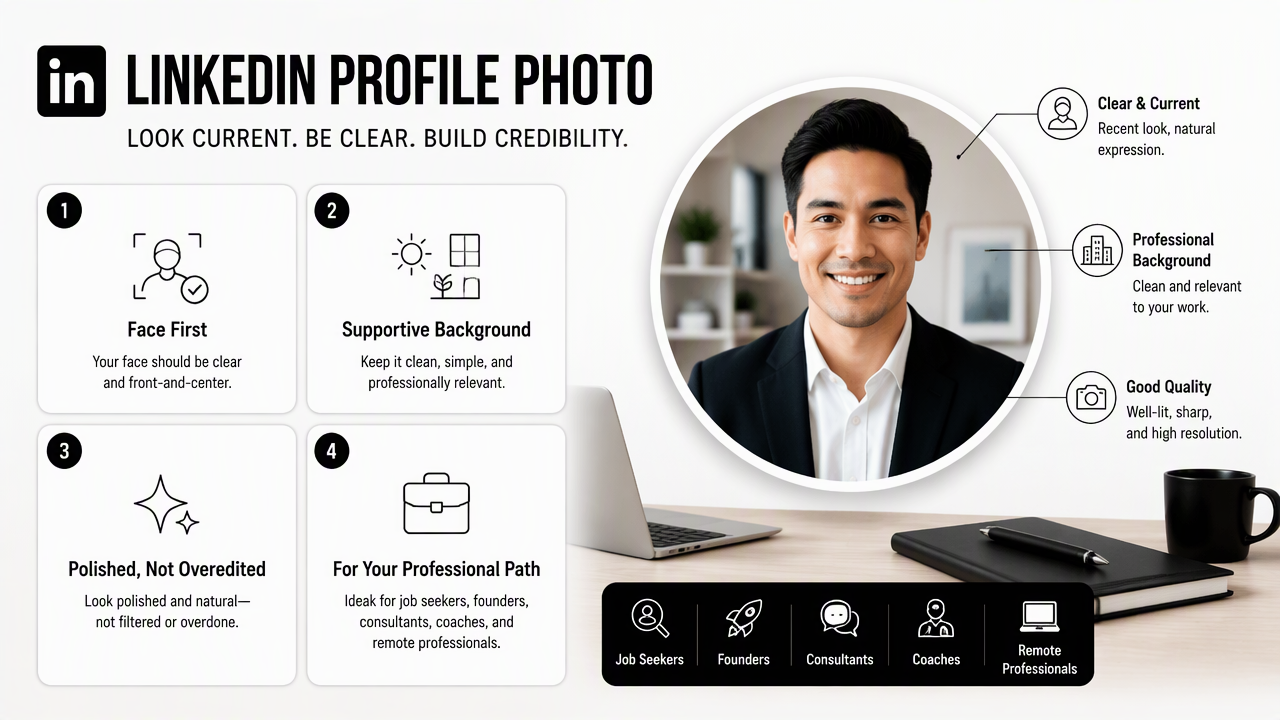
LinkedIn users should usually choose a head-and-shoulders crop, soft natural light, and an expression that matches the field. A finance executive may need a sharper, more formal image. A fitness coach, creator, or startup founder may benefit from a warmer image with clearer brand personality.
People creating business-facing visuals can use a specialized option such as a fitness LinkedIn profile picture AI generator when the goal is a sharper professional identity tied to a specific niche. The best result still depends on believable posture, consistent styling, and a face that remains easy to identify.
LinkedIn photo checklist
- Use a recent image that still looks like the person offline.
- Keep the eyes visible, sharp, and well-lit.
- Crop from mid-chest or shoulders upward.
- Choose a clean background with low visual noise.
- Match clothing to the audience: employer, client, investor, or peer network.
- Avoid heavy filters, novelty props, or dramatic shadows.
A LinkedIn banner can reinforce the headshot without repeating it. A coach, personal trainer, or consultant can pair a clean headshot with a fitness LinkedIn banner AI generator to create a more complete profile identity.
LinkedIn headshot mistakes to avoid
Common weak points include cropped group photos, old graduation photos, harsh flash, sunglasses, cluttered backgrounds, and images where the face is too small. These choices create friction because viewers must work harder to understand identity and credibility.
Over-polishing can also backfire. Skin that looks plastic, backgrounds that look fake, or outfits that do not match the person's actual role can reduce trust. A slightly natural image often beats a perfect but unbelievable one.
What kind of Slack profile picture works best at work?
A Slack profile picture works best when coworkers can recognize the person instantly in a small circular crop. Slack is a workplace communication platform from Slack Technologies, a company founded in 2009, and its avatar appears inside fast-moving message threads, notifications, and channel lists.
Slack photos do not need the same formal polish as LinkedIn. A friendly, well-lit close-up usually performs better than a distant professional portrait. The image should help colleagues attach tone and identity to short messages, especially across remote and hybrid teams.
Cristina Miguel, Christoph Lutz, and Rodrigo Perez-Vega examined loneliness among digital nomads and social media use for relationships in a 2024 Media, Culture & Society study. That topic matters for remote work because small identity signals, including profile images, can make digital communication feel more human.
Slack avatar do's and don'ts
- Do use a close crop with the face centered.
- Do choose a relaxed expression rather than a stiff corporate pose.
- Do keep the background simple because Slack thumbnails are small.
- Do update the image after major appearance changes.
- Don't use tiny full-body photos.
- Don't use logos unless the account represents a brand, not a person.
- Don't rely on joke avatars in client-facing workspaces.
A creator or entrepreneur who uses Slack for client communities may also need matching visuals across work channels and public marketing. In that case, a consistent image style can carry into a fitness newsletter profile picture generator or similar audience-facing asset.
Which photos work best for dating apps?
Dating app photos work best when the first image is clear, well-lit, current, and inviting, followed by supporting photos that show personality, lifestyle, and body shape honestly. Dating profiles should not look like corporate résumés; they need warmth, context, and variety.
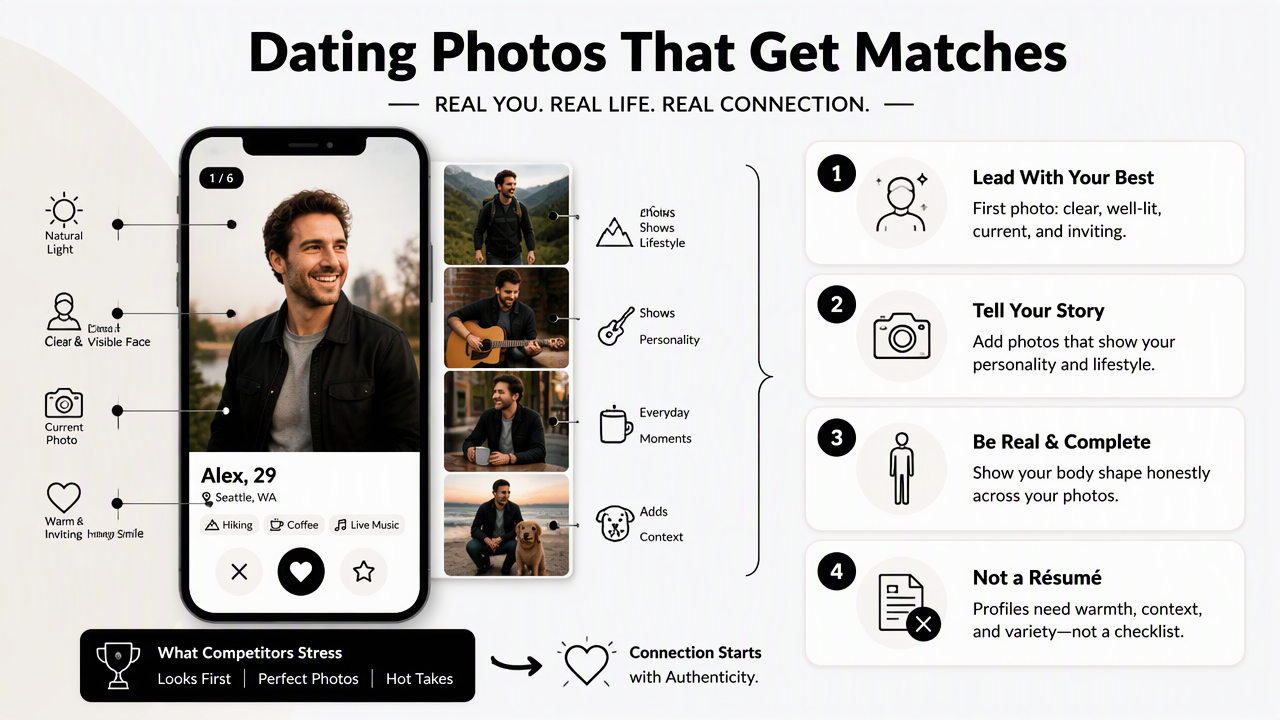
Competitor dating guides often stress the first image, body framing, clothing, and hand placement. That advice is useful, but it becomes stronger when translated into a simple profile sequence: face, body, activity, social proof, and personal detail. The goal is not maximum glamour. The goal is believable attraction.
Key insight: dating photos should reduce uncertainty, not create a fantasy version of the person.
The first photo should usually be a solo image with direct visibility of the face. Group photos belong later, if used at all. A dating profile can look more trustworthy when it includes at least one relaxed full-body or half-body image, since it gives viewers more context.
Best dating app photo sequence
- Primary face photo: clear eyes, natural smile, no sunglasses.
- Half-body or full-body photo: honest framing, flattering posture.
- Lifestyle photo: hiking, cooking, art, sport, travel, music, or another real interest.
- Social-context photo: one clear group or event image where the person is easy to identify.
- Personal detail photo: pet, hobby, favorite setting, or signature style.
For creators and active professionals, the same source images can be adapted for social platforms. A public-facing fitness professional, for example, may use a more energetic version through a fitness Instagram profile picture AI generator, while keeping the dating app version softer and less promotional.
Dating app photo pitfalls
Weak dating photos often hide too much: sunglasses in every shot, hats in every shot, distant bodies, mirror selfies, heavy filters, or only group photos. These choices create doubt because they make basic visual information hard to read.
Highly staged professional photos can also feel mismatched on dating apps. A polished image is fine, but the profile should still include candid-looking frames, everyday clothing, and settings that suggest real life rather than a campaign shoot.
How can one photo system serve work, creator, and dating profiles?
One photo system can serve work, creator, and dating profiles by starting with a flexible set of source images, then cropping, styling, and selecting different versions for each platform. The strongest system includes one polished headshot, one relaxed close-up, one lifestyle image, and one context-rich full-body image.
K. J. Kevin Feng, Xander Koo, and Lawrence Tan's 2024 research on teachable social media feed experiences, available through ACM, points to a broader trend: people increasingly shape digital feeds and identity signals with more control. Profile photos are part of that controlled identity layer.
Looktara fits that workflow because the Looktara platform can generate profile-ready images for different professional and social contexts without requiring a studio session. For brand recall and direct access, readers can visit looktara.com after deciding which platform needs the first upgrade.
Reusable profile photo kit
| Image type | LinkedIn use | Slack use | Dating app use | Creator use |
|---|---|---|---|---|
| Polished headshot | Primary profile photo | Optional | Too formal for primary | About page or media kit |
| Relaxed close-up | Secondary option | Best option | Strong primary option | Community profile |
| Lifestyle image | Featured post support | Rare | Strong supporting photo | Strong profile or post asset |
| Full-body image | Not usually needed | Not needed | Important supporting image | Useful for personal brand |
| Branded visual | Banner or post | Workspace brand account | Usually avoid | Strong for creator identity |
Entrepreneurs who publish across LinkedIn and social platforms can also create supporting visuals with a fitness Instagram LinkedIn post AI generator. That keeps the face, tone, and offer visually aligned across channels.
What to expect in 2027
Profile photos will likely become more platform-specific as AI-generated imagery becomes more common. Authenticity signals will matter more, not less. Viewers will look for small signs of reality: natural skin texture, believable lighting, consistent facial features, and images that match other public profiles.
With Looktara, the practical approach is to create variations that look polished but still human. The safest 2026 strategy going into 2027 is not a single perfect image; it is a small, consistent set of photos that match each platform's social contract.
FAQ
The most common profile photo questions come down to fit: how formal the image should be, whether AI-generated images are acceptable, and how often photos should change. Good answers depend on platform intent, not one universal rule.
Can the same photo be used for LinkedIn, Slack, and dating apps?
The same photo can be used across platforms if it is recent, clear, friendly, and not overly formal. Still, better results usually come from small variations. LinkedIn benefits from a polished crop, Slack from a recognizable close-up, and dating apps from a warmer image that feels less corporate.
Are AI-generated profile pictures acceptable in 2026?
AI-generated profile pictures are acceptable when they look realistic, match the person accurately, and fit the platform. Problems appear when the image changes facial structure, removes natural texture, or creates an outfit and setting that misrepresent real identity. Believable editing matters more than obvious perfection.
How often should a profile picture be updated?
A profile picture should be updated after a major appearance change, career shift, rebrand, or move into a more public-facing role. Many professionals benefit from refreshing core images every one to two years, especially when the old image no longer matches current hair, style, or level of seniority.
What is the safest background for a profile picture?
The safest background is simple, bright, and low-clutter. LinkedIn usually works best with a neutral office, clean wall, or subtle brand setting. Slack needs an uncluttered background for small display sizes. Dating apps can use more natural settings, such as outdoor light, cafés, hobbies, or relaxed social spaces.
Conclusion
The best profile pictures for LinkedIn Slack and dating apps are platform-specific, not one-size-fits-all. LinkedIn needs credible polish, Slack needs quick recognition, and dating apps need real warmth and variety. The next step is simple: choose the weakest current profile first, build a small photo kit around that use case, then adapt the strongest images across other platforms. For a faster upgrade path, head to looktara.com and create profile-ready visuals that match the role, audience, and channel.
Generated by EarlySEO.com