
TL;DR
Free AI headshot generators work best for casual testing, dating profiles, and low-risk social updates. Paid tools are usually the safer choice for LinkedIn, resumes, founder bios, sales pages, and brand campaigns because they offer stronger likeness control, higher resolution, and clearer usage terms.
A headshot now has to work harder than a passport photo: it may appear on LinkedIn, a speaker page, a dating profile, a founder deck, and paid ads in the same week. The artificial intelligence photo generator free vs paid for headshots debate comes down to one question: how public, professional, and reusable does the final image need to be?
Artificial intelligence photo generator: a software tool that uses AI systems, often image generation or enhancement models, to create, edit, or restyle profile photos from uploaded images or prompts.
For people building a visible professional presence, Looktara fits into the broader visual-brand workflow around polished profile imagery, social graphics, and campaign assets. A strong headshot should also match surrounding materials, from a fitness Shopify landing page banner to social posts and display ads.
Table of Contents
What is an AI headshot generator?
An AI headshot generator is a photo tool that creates or improves portrait-style images using artificial intelligence, usually by analyzing facial features, lighting, clothing, pose, and background patterns. For headshots, the goal is not fantasy art; the goal is a believable, flattering image that still looks like the real person.
Artificial intelligence broadly refers to computational systems that perform tasks associated with human intelligence, including perception, learning, reasoning, and problem-solving. AI visual art usually means imagery generated or enhanced through AI programs, commonly text-to-image or image-to-image models.
Key insight: A useful AI headshot is not just sharp or attractive; it must preserve identity, fit the platform, and avoid looking synthetic.
Professional headshots have stricter requirements than casual AI avatars. A hiring manager, client, or date needs a face that feels current and trustworthy. A model that changes eye shape, age, skin texture, or facial proportions too much can create a polished image that fails the real-world recognition test.
Core headshot terms
- Likeness: how closely the generated image resembles the real person.
- Identity consistency: whether multiple outputs preserve the same face across poses and outfits.
- Resolution: the image size and clarity needed for LinkedIn, websites, print, and ads.
- Commercial rights: permission to use the photo for business, marketing, or client-facing purposes.
- Style control: the ability to choose backgrounds, wardrobe direction, lighting, crop, and mood.
How do free and paid AI headshot generators differ?
Free and paid AI headshot generators differ most in likeness control, output resolution, editing depth, privacy terms, and commercial usability. Free tools are useful for experimentation, while paid tools are better suited to public-facing professional images that must look realistic across multiple channels.
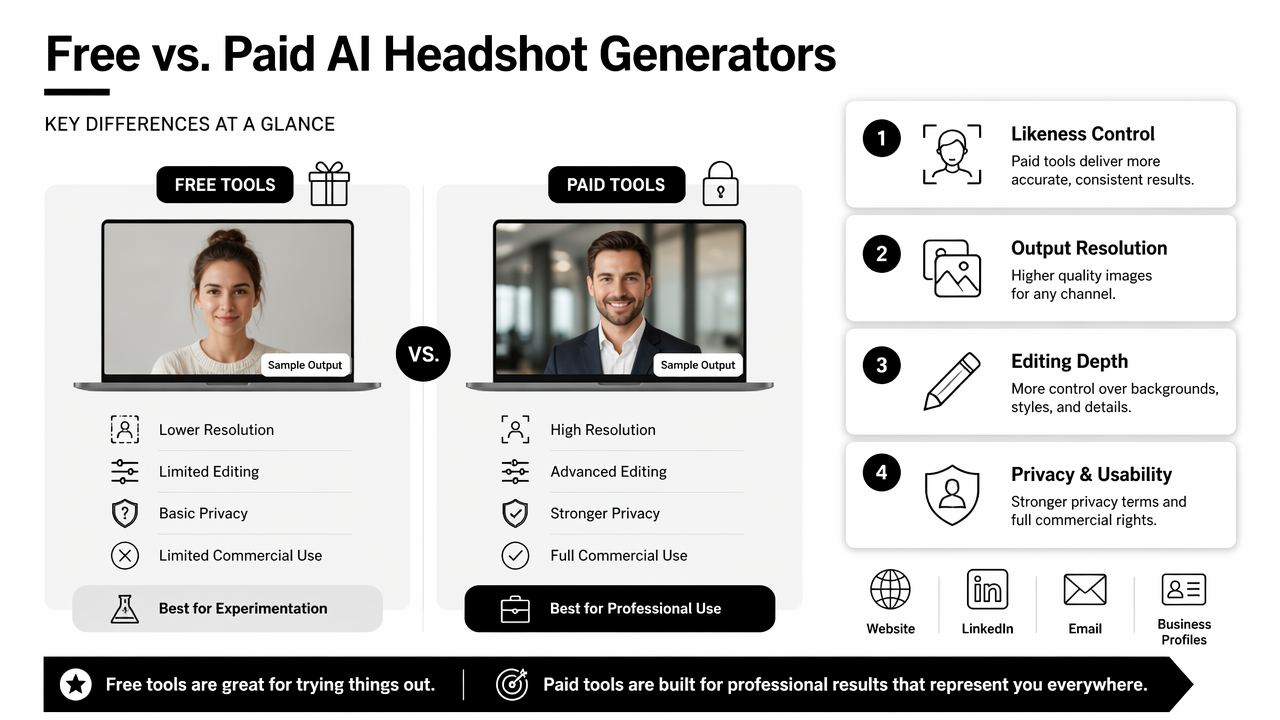
Free tools often provide a quick preview, a limited number of credits, or basic retouching. Paid tools usually offer more outputs, stronger model tuning, higher-quality exports, background choices, outfit variations, and clearer license language.
The distinction matters because headshots are identity assets, not generic graphics. Research by Sergi D. Bray, Shane D. Johnson, and Bennett Kleinberg in the Journal of Cybersecurity examined human ability to detect deepfake images of faces, showing why realistic synthetic portrait evaluation has become a serious topic for digital trust and authentication (2023 study).
Free vs paid headshot comparison table
| Evaluation area | Free AI photo generator | Paid AI headshot generator |
|---|---|---|
| Realism | Good for tests, often inconsistent | More consistent lighting, skin texture, and facial detail |
| Likeness | May drift from the real face | Usually stronger identity preservation |
| Resolution | Often limited or watermarked | Higher-resolution files for web, print, and profiles |
| Style control | Basic prompts or presets | More control over wardrobe, background, and crop |
| Commercial use | Terms may be unclear or limited | More likely to include business-use permissions |
| Privacy controls | Varies widely by provider | Often clearer deletion, storage, or consent policies |
| Best use | Casual profiles, drafts, experiments | LinkedIn, resumes, websites, PR, ads, and founder bios |
When is a free AI photo generator enough?
A free AI photo generator is enough when the image is low-stakes, temporary, or used for private testing rather than formal professional identity. It can help compare styles, test backgrounds, and learn which expressions or crops work before paying for a polished headshot set.
Free tools make sense when perfection is not required. A creator testing profile aesthetics, a freelancer exploring different brand moods, or a dating app user refreshing photos may benefit from fast, no-cost outputs.
Useful free-tool scenarios include:
- Testing whether a neutral, warm, or high-contrast background fits a profile.
- Comparing crops for LinkedIn, Instagram, and dating apps.
- Trying business-casual versus formal wardrobe direction.
- Creating rough drafts before ordering professional image sets.
- Checking whether an existing selfie has enough quality for AI enhancement.
Free outputs also help align a headshot with surrounding content. For example, a fitness entrepreneur may compare a headshot style against a fitness Instagram post design, a fitness Shopify logo concept, or a product launch visual before committing to a final image direction.
Key insight: Free AI headshots are best treated as a style lab, not the final identity image for high-trust situations.
Several issues still need checking before using a free image publicly. The face should match current appearance, hands and clothing should not contain artifacts, skin should not look plastic, and the license should permit the planned use.
Free headshot quality checklist
- Compare the generated face against a recent real photo.
- Zoom in on eyes, teeth, hairline, ears, and jaw shape.
- Check clothing seams, buttons, collars, and glasses.
- Confirm the image exports without a watermark.
- Read usage terms before placing the image on a business page.
- Test the photo at small profile sizes, not only full-screen.
When is a paid AI headshot worth it?
A paid AI headshot is worth it when the image affects hiring, sales, media credibility, investor trust, or customer conversion. In these cases, the value is not just a better-looking photo; the value is lower risk, higher consistency, and more usable files.
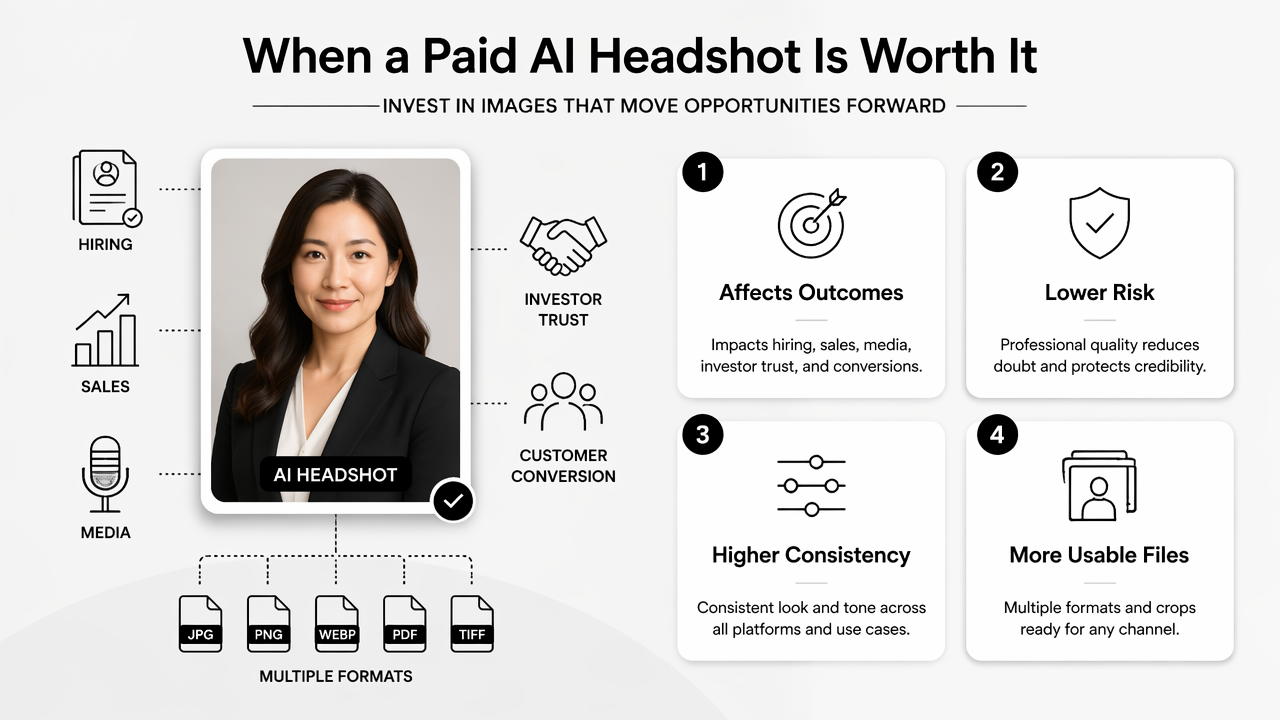
Paid tools matter most when the same person needs multiple portraits across formal and casual settings. A job seeker may need LinkedIn and resume-ready crops. A founder may need a press photo, speaker bio image, and website portrait. A creator may need brand-aligned photos for multiple platforms.
Professional-facing use cases often require:
- Multiple outfit and background options.
- Crops for square, vertical, and horizontal placements.
- High-resolution exports.
- Cleaner skin detail without over-editing.
- Consistent likeness across a gallery.
- Clear business-use permissions.
The broader concern is trust. A 2023 survey on audio deepfakes by Zahra Khanjani, Gabrielle Watson, and Vandana P. Janeja reviewed synthetic media risks in another modality, but it reinforces the same practical theme: generated media needs careful handling when identity and credibility are involved (Frontiers in Big Data survey).
For business owners, a headshot rarely stands alone. The Looktara platform can help keep profile imagery consistent with supporting visuals, such as a fitness Instagram Google display ad or a fitness Shopify TikTok cover, so public-facing assets feel coordinated rather than pieced together.
Best choice by use case
| Use case | Better choice | Why it fits |
|---|---|---|
| LinkedIn job search | Paid | Stronger likeness, cleaner crop, professional polish |
| Resume or CV | Paid | Low tolerance for artifacts or identity drift |
| Dating app profile | Free or paid | Depends on desired polish and authenticity |
| Founder website | Paid | Public trust and brand consistency matter |
| Social media test | Free | Fast style exploration with low risk |
| Paid advertising | Paid | Commercial usage rights and resolution matter |
| Internal team directory | Free or paid | Depends on company standards and privacy rules |
How should headshot buyers choose in 2026?
Headshot buyers should choose based on risk, realism, rights, and reuse rather than price alone. The cheapest option can work for casual testing, but professional identity images need enough control to prevent misleading likeness, poor resolution, or unclear licensing.
A practical decision process keeps the choice simple:
- Define the main channel: LinkedIn, resume, website, dating app, speaker bio, or ad.
- Decide whether the image must support commercial use.
- Check if multiple crops or styles are needed.
- Review privacy and image-deletion terms.
- Test realism at thumbnail size and full size.
- Choose paid generation when credibility or revenue is tied to the image.
A common misconception is that a more attractive AI image is automatically better. For headshots, believability beats glamour. The right photo should make recognition easier, not create a different face.
Research by D. Tiffany, Steve Zelenty, and Mar González-Franco introduced a perceptually validated virtual avatar library focused on inclusion and diversity, which points to a wider 2026 trend: synthetic human imagery is being judged not only by aesthetics, but also by representation, perception, and suitability for real contexts (Frontiers in Virtual Reality, 2023).
Looking into 2027, AI headshot tools will likely compete less on novelty and more on identity safeguards, consent controls, editable style systems, and platform-specific export formats. Buyers should expect more disclosure options, stronger photo-to-photo consistency, and tighter integration between headshots and brand asset creation.
Key insight: The winning headshot workflow in 2026 is not free versus paid; it is low-risk testing first, then paid polish when the image represents a professional identity.
FAQ about free vs paid AI headshots
The most common AI headshot questions center on realism, ownership, safety, and whether free tools can replace paid services. Short answers help separate casual use from professional use.
Are free AI headshot generators really free?
Some free AI headshot generators are free for limited use, such as previews, basic edits, or a small number of exports. Others may require sign-up, apply watermarks, limit resolution, or reserve stronger features for paid plans. The practical question is not only cost, but whether the final image can be downloaded and used where needed.
Can AI headshots be used on LinkedIn?
AI headshots can be used on LinkedIn when they look realistic, match the real person, and meet the platform's professional norms. A suitable LinkedIn image should show a clear face, natural lighting, and current appearance. Over-stylized images, heavy facial changes, or synthetic-looking skin can reduce trust.
Do paid AI headshots replace a photographer?
Paid AI headshots can replace a photographer for many profile, resume, and website needs, especially when speed and budget matter. A photographer may still be better for executive campaigns, group shoots, editorial portraits, or highly controlled brand sessions. The best choice depends on stakes, budget, and required creative direction.
What should be checked before publishing an AI headshot?
Before publishing an AI headshot, the profile owner should check likeness, eye detail, hairline, skin texture, clothing, background, resolution, and usage rights. The image should also be tested as a small thumbnail. Many headshot problems are easier to notice after zooming in and comparing the output with recent real photos.
Conclusion
The artificial intelligence photo generator free vs paid for headshots choice is simple when the image's job is clear. Free tools are a smart first step for experiments, style testing, and casual profiles. Paid tools are the better fit when the photo supports hiring, sales, personal branding, or any channel where recognition and trust matter.
For a practical next step, a profile owner can gather 8 to 12 recent selfies, test a few low-risk styles, then choose a paid workflow for the final professional set if the image will appear on LinkedIn, a website, ads, or a public bio. For visual consistency beyond the headshot, Looktara can support surrounding brand assets, including social graphics and campaign visuals. Visit looktara.com when the headshot needs to fit a larger professional presence.
Generated by EarlySEO.com