
TL;DR
AI photo generators help business owners create professional headshots, founder portraits, social visuals, and ad creative faster than traditional shoots. The best results come from matching image style to brand positioning, using consistent prompts, and saving polished outputs for LinkedIn, websites, ads, and content channels.
A single weak profile photo can make a strong business look less credible before a prospect reads a word. An artificial intelligence photo generator for business owners solves that problem by turning simple inputs, such as selfies, prompts, or brand directions, into polished visuals for profiles, websites, social media, and campaigns. Looktara gives entrepreneurs a practical way to create business-ready imagery without booking a full studio session for every update.
Artificial intelligence photo generator: A software tool that uses AI models to create, edit, or enhance images from text prompts, uploaded photos, or style instructions.
Key takeaway: business owners do not need one "perfect" image. They need a small, consistent image set that supports trust across LinkedIn, websites, bios, ads, and social platforms.
Table of Contents
What is an artificial intelligence photo generator for business owners?
An artificial intelligence photo generator for business owners is a tool that creates professional-looking images for founder branding, marketing, hiring, sales, and social proof using AI models trained to generate or improve visual content.
Unlike a general image generator, a business-focused photo workflow has a commercial job to do. It must make a founder, team, product, or brand feel credible in the exact place where a buyer sees it.
Artificial intelligence is commonly defined as the capability of computational systems to perform tasks linked with human intelligence, such as perception, reasoning, learning, and problem-solving. AI visual art refers to images generated or enhanced through AI programs, often through text-to-image models.
For business owners, the output should feel less like novelty art and more like a practical brand asset. That can include a LinkedIn headshot, a website hero image, a speaker bio portrait, a testimonial graphic, a dating profile refresh for a public-facing founder, or a campaign image sized for paid media.
Business image types that AI can support
A strong AI photo set usually covers several business uses instead of only one headshot.
- Founder headshot: LinkedIn, media kit, company bio, investor update
- Personal brand portrait: About page, podcast guest page, newsletter header
- Social content image: Instagram, TikTok, X, Pinterest, LinkedIn
- Ad creative: Facebook, Instagram, Google Display, YouTube thumbnails
- Event or speaking visual: Conference bio, webinar page, digital poster
Business owners in fitness, coaching, wellness, ecommerce, real estate, consulting, and creator-led brands often need the same face presented in several formats. A professional profile photo may work for LinkedIn, while a warmer lifestyle image may fit an Instagram Story or landing page.
Looktara fits this use case because the Looktara platform connects brand imagery with practical output formats. For example, a fitness entrepreneur can pair a professional portrait workflow with a resume and headshot image generator and then create matching assets for channels that need different visual crops.
Why business owners use AI photos instead of repeat photo shoots
Business owners use AI photos because professional imagery changes faster than traditional photo production cycles can handle.
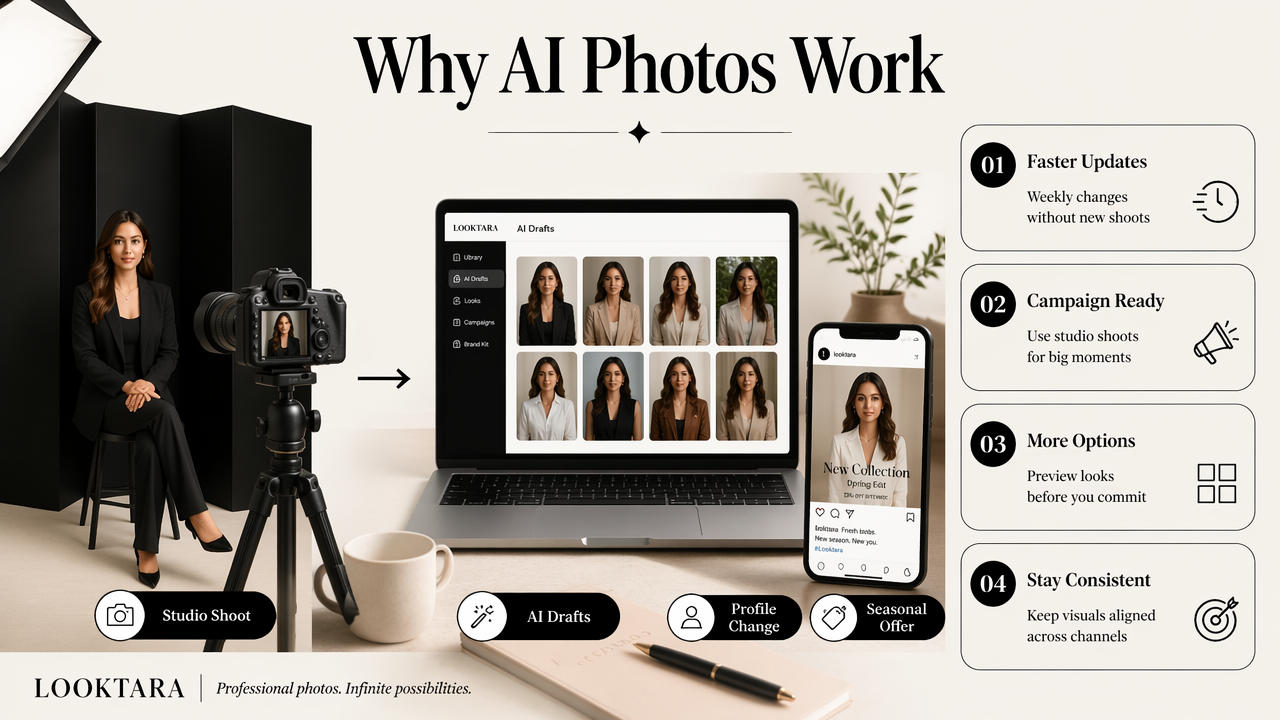
A studio shoot still has value for major campaigns, packaging, press launches, and large brand moments. The problem is that small business marketing rarely happens in one big launch. It happens in weekly updates, profile changes, seasonal offers, new services, new funnels, and fresh content needs.
AI image generation can reduce friction across that routine work. It gives a founder more usable options before committing to final creative, and it helps maintain a visual identity across places where the same business appears.
Research in adjacent AI fields supports the broader direction. A 2022 IEEE Access paper on metaverse systems by Sangmin Park and Young-Gab Kim examined taxonomies, components, applications, and open challenges in immersive digital systems, where AI-generated visual assets are part of broader digital identity work source. A 2022 Automation in Construction study by Shanaka Kristombu Baduge and coauthors reviewed machine learning and deep learning methods for smart vision in construction 4.0, showing how visual AI is moving into practical commercial workflows beyond art and entertainment source.

AI photos versus traditional business shoots
The best choice depends on the business moment, budget, timeline, and risk level.
| Use case | AI photo generator | Traditional photo shoot | Best fit |
|---|---|---|---|
| LinkedIn profile update | Fast, flexible, low planning | Polished but slower | AI for frequent updates |
| Website founder image | Good for fast launches | Best for flagship sites | Hybrid approach |
| Ad concept testing | Many variations quickly | Costly for each variation | AI first, shoot winners later |
| Product packaging | Riskier if accuracy matters | Better control and compliance | Traditional shoot |
| Team page consistency | Useful for remote teams | Harder to schedule | AI for distributed teams |
Practical rule: use AI to create and test the visual direction, then reserve traditional shoots for high-stakes assets where exact product detail, legal review, or premium art direction matters most.
Where AI photos save the most time
Business owners often gain the biggest speed advantage in recurring content tasks, not one-time brand launches.
A founder who posts on LinkedIn can use AI-assisted portraits with a LinkedIn post image generator to keep visuals consistent without rebuilding design files each week. A creator-led fitness store can adapt the same image style into Pinterest pin creative, keeping brand colors and subject style recognizable across channels.
This matters because brand trust is built through repetition. When a profile photo, ad image, and content graphic look unrelated, the business feels less established than it may actually be.
How should business owners choose AI photo styles?
Business owners should choose AI photo styles by matching the image mood, clothing, background, lighting, and crop to the brand promise and customer expectation.
A luxury consultant, a gym founder, a dating coach, and a local accountant should not use the same portrait style. The right photo tells prospects what kind of experience to expect before the first call, form fill, or purchase.
A simple framework helps avoid random image choices: brand position first, platform second, style third. The image should support the business model, not chase whatever prompt looks trendy that week.
Brand style framework for AI business photos
Use this table as a style map before generating images.
| Brand position | Best visual mood | Suggested setting | Avoid |
|---|---|---|---|
| Premium advisor | Calm, confident, refined | Office, neutral studio, city interior | Overly casual poses |
| Fitness founder | Energetic, healthy, direct | Gym, outdoor training, clean studio | Unreal body changes |
| Creative entrepreneur | Warm, expressive, modern | Workspace, color backdrop, lifestyle scene | Generic corporate stock look |
| Local service owner | Trustworthy, approachable | Storefront, neighborhood, simple office | Over-edited glamour styling |
| Dating profile professional | Natural, relaxed, attractive | Cafe, park, soft daylight | Stiff business portrait |
Style decisions should also account for platform behavior. LinkedIn favors clarity and professionalism. Instagram allows more personality. TikTok thumbnails need stronger contrast and expressive framing. Website hero images need empty space for text.
Prompt ingredients that improve brand consistency
Clear prompts produce more useful business images than vague requests.
- Subject role: founder, coach, consultant, stylist, freelancer, broker
- Brand tone: polished, friendly, bold, calm, premium, creative
- Setting: studio, office, gym, cafe, outdoor city, home workspace
- Wardrobe: blazer, neutral shirt, athletic wear, smart casual, brand colors
- Lighting: soft daylight, clean studio light, warm indoor light
- Output use: LinkedIn headshot, website hero, ad creative, thumbnail
A fitness business owner, for example, may create a clean founder portrait, then adapt the same brand feel into a TikTok cover image or a YouTube thumbnail. The goal is recognition, not identical images everywhere.
Strong brand imagery feels consistent without looking copied and pasted.
What mistakes make AI business photos look unprofessional?
AI business photos look unprofessional when they over-polish the subject, distort identity, ignore platform context, or create a style that does not match the business.
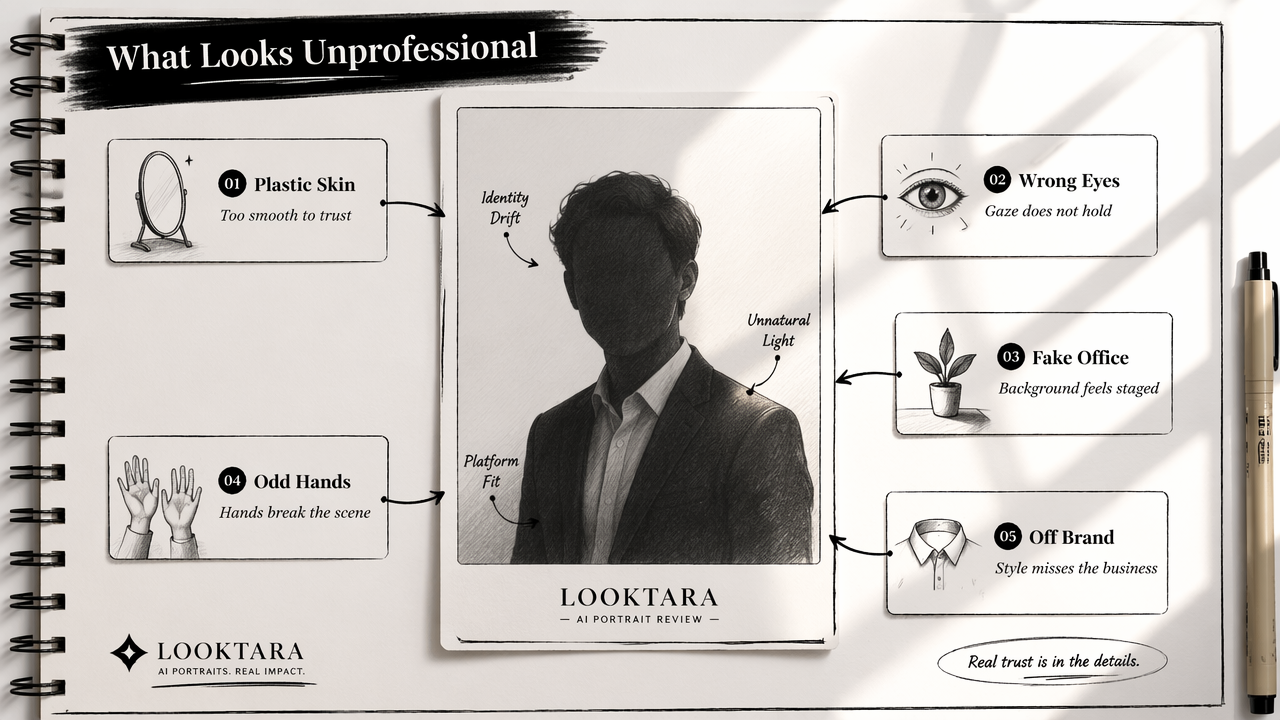
The biggest risk is not that an image looks AI-generated. The bigger risk is that it looks untrustworthy. Prospects notice when a portrait feels plastic, a background feels fake, or a founder appears different across channels.
Common quality problems include unnatural skin texture, inconsistent eye direction, odd hands, fake office details, impossible lighting, and clothing that does not match the brand. These issues can reduce credibility even when the photo is technically sharp.
Quality checklist before publishing
Every AI-generated business photo should pass a simple review before going live.
- Face, eyes, teeth, hands, and hair look natural
- Clothing matches the business category and customer expectation
- Background does not contain fake text, warped objects, or brand conflicts
- Lighting fits the platform and does not look overly dramatic
- The person remains recognizable across all public profiles
- Image crop works on mobile, desktop, and circular profile frames
- No claims are implied that the business cannot support
AI photos also need ethical judgment. A headshot can improve lighting, styling, and setting, but it should not create a misleading identity. Business owners should avoid fake credentials in backgrounds, unrealistic body changes, invented team members, and staged client scenarios that never happened.
When a real photographer still makes sense
Traditional photography remains the better choice for some assets.
A real shoot is safer for regulated industries, detailed product demonstrations, facility tours, medical or legal trust signals, and major press features. Product detail also matters. If an ecommerce item has specific stitching, ingredients, size, or packaging, AI should not replace accurate product photography.
That said, AI-generated brand photos can still support the surrounding content system. A founder can use AI for social posts, profile refreshes, and early campaign testing while reserving original photography for final product pages and high-risk proof points.
How will AI brand photography change in 2027?
AI brand photography in 2027 will likely become more personalized, format-aware, and connected to full marketing workflows.
The shift is already visible. Business owners no longer need only a headshot. They need image systems that include portraits, ad assets, social covers, thumbnails, banners, and platform-specific creative. AI tools are moving from single-image generation toward brand kits that remember identity, colors, voice, and recurring campaign needs.
A 2021 review by Guo Liu, Xiaofeng Zhang, and Xuliang Chen on additive manufacturing of structural materials focused on advanced production methods rather than marketing imagery, but it reflects a wider trend: digital generation is becoming part of how businesses prototype, test, and produce assets across industries source.
What to expect next
Business owners should expect AI image tools to become more operational and less experimental.
- Better identity consistency across image sets
- More platform-specific templates for ads, thumbnails, and profile images
- Stronger editing controls for face, wardrobe, background, and crop
- Better brand memory for colors, logo placement, and visual tone
- Clearer disclosure and rights management for commercial use
For small teams, that means fewer disconnected tools. A founder may create a profile portrait, campaign banner, Instagram ad, and website visual from one brand direction. Looktara is well placed for that workflow because it focuses on practical business outputs rather than isolated image experiments.
FAQ for business owners using AI photos
AI-generated photos are best treated as business assets that need review, context, and a clear publishing goal.
Are AI-generated business photos acceptable for LinkedIn?
AI-generated business photos are acceptable for LinkedIn when they remain accurate, professional, and recognizable. The image should look like the actual person, use realistic lighting, and avoid exaggerated retouching. A clear head-and-shoulders crop with simple clothing usually performs better than a dramatic editorial image.
Can AI photos replace a professional photographer?
AI photos can replace a photographer for many routine profile and content needs, but not every business use. Traditional photography is still better for product accuracy, press campaigns, events, facilities, and regulated trust signals. Many owners use AI for fast content and reserve photographers for flagship assets.
What photos should a founder create first?
A founder should create a core set first: one LinkedIn headshot, one website portrait, one relaxed personal brand image, one social post image, and one ad-ready crop. That set covers most early business needs without creating visual clutter.
How can AI photos support paid ads?
AI photos can support paid ads by creating multiple visual concepts for testing before a business spends heavily on production. For fitness and creator-led brands, assets can be adapted into Instagram and Facebook ad creative with consistent subject styling and channel-ready dimensions.
Conclusion
The best artificial intelligence photo generator for business owners is the one that turns a founder's identity into a consistent set of usable brand assets, not just a single polished portrait. A strong workflow starts with brand positioning, creates several platform-specific images, checks each output for realism, and saves the best versions for profiles, websites, ads, and social content.
For a practical next step, business owners can list the five places where their face or brand image appears most often, then create one image style for each placement. With Looktara, that process can move from headshot to content asset to campaign creative in one organized workflow. For more business-ready image formats, visit looktara.com and build a visual set that matches the brand before the next profile update or campaign launch.
Generated by EarlySEO.com