
TL;DR
AI brand image sets work best when treated as a planned photo library, not a single headshot. The strongest set includes consistent outfits, backgrounds, crops, lighting, and channel-specific formats for LinkedIn, websites, social posts, speaker bios, and creator profiles.
A single polished portrait rarely carries a modern personal brand across LinkedIn, websites, newsletters, podcasts, creator channels, and dating apps. An artificial intelligence photo generator for brand image sets helps create a coordinated library of images with consistent identity, tone, framing, and channel fit. AI photo generator: a tool that uses artificial intelligence, including text-to-image or image-to-image models, to create or enhance photos from prompts, references, or uploaded images. Looktara fits this shift by helping professionals think beyond one profile photo and toward a usable image system.
Table of Contents
What is an artificial intelligence photo generator for brand image sets?
An artificial intelligence photo generator for brand image sets creates multiple coordinated portraits and marketing images that share a recognizable person, style, color mood, and professional context. Instead of producing one avatar, it supports a visual library for headshots, bios, social posts, website sections, thumbnails, and campaign assets.
Artificial intelligence is commonly defined as the ability of computational systems to perform tasks linked with human intelligence, such as perception, learning, reasoning, and problem-solving. AI art refers to visual work generated or enhanced through AI programs, most often text-to-image models.
A 2023 review in Future Internet examined generative AI requirements, models, input-output formats, evaluation metrics, and challenges, which helps explain why prompt quality, reference inputs, and review standards matter in image generation workflows (Bandi, Adapa, and Kuchi, 2023).
Key insight: A brand image set should be judged by consistency across use cases, not by the best single image in the batch.
Core terms:
- Brand image set: A planned group of profile, promotional, and social images built around one recognizable visual identity.
- Reference image: An uploaded photo that guides likeness, pose, style, or composition.
- Prompt: Written direction that describes clothing, location, lighting, mood, crop, and output format.
- Channel crop: A size or composition tailored for LinkedIn, website hero sections, TikTok covers, YouTube thumbnails, or speaker pages.
How should a brand image set be planned before generation?
A brand image set should be planned by mapping each photo to a channel, audience, crop, outfit, background, and emotional tone before any prompt is written. Planning first reduces random outputs and makes the final library useful for professional profiles, business pages, social campaigns, and creator content.
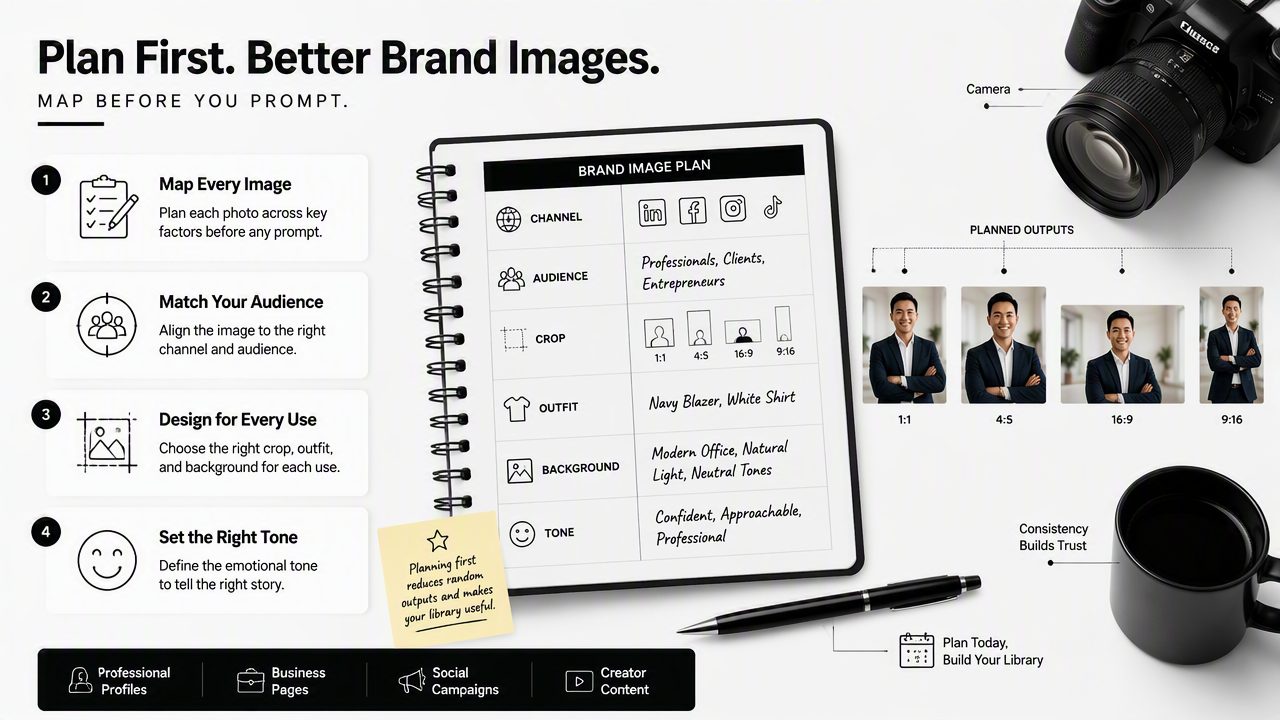
The strongest planning starts with identity rules. A founder may need approachable authority. A job seeker may need trust and clarity. A fitness creator may need energy, movement, and clean product space.
Brand image set planning matrix
| Use case | Best crop | Outfit direction | Background direction | Tone |
|---|---|---|---|---|
| LinkedIn profile | Head and shoulders | Blazer, knit, clean shirt | Soft office, neutral wall | Credible and warm |
| Website hero | Waist-up or wide | Brand-color accents | Studio, workspace, lifestyle scene | Confident and clear |
| Speaker bio | Chest-up | Formal or smart casual | Conference, stage, editorial wall | Expert and composed |
| Social post | Square or vertical | Casual brand wardrobe | Lifestyle, gym, office, city | Relatable and active |
| Dating profile | Natural portrait | Relaxed, well-fitted clothes | Outdoor, cafe, hobby setting | Authentic and open |
A practical set also needs visual constraints. Limit the palette to two or three brand colors, choose one lighting family, and repeat two or three backgrounds. Too much variety can make the person look like several different brands.
Sequential planning works best:
- Define the main audience and desired impression.
- Select 4 to 6 channels that need images.
- Choose 2 outfit families, such as formal and casual.
- Pick 2 background families, such as studio and lifestyle.
- Assign crops by channel before generation.
- Review the set as a grid, not one image at a time.
For profile-first needs, a dedicated resume headshot AI generator can anchor the set before social and website variations are created.
How does AI keep brand photos consistent across channels?
AI keeps brand photos consistent by repeating reference inputs, style instructions, wardrobe rules, background categories, and composition standards across multiple outputs. The model may generate variation, but the brand system comes from controlled prompts, careful selection, and human review.
A 2021 review of artificial intelligence in the creative industries covered AI's growing role in creative production, which supports a practical point: AI works best as part of a directed creative workflow, not as an unsupervised replacement for brand judgment (Anantrasirichai and Bull, 2021).
Consistency depends on three layers:
- Identity consistency: The person should remain recognizable across poses, crops, expressions, and settings.
- Visual consistency: Lighting, contrast, color temperature, and background depth should feel related.
- Message consistency: Each image should match the channel's purpose, such as hiring, selling, teaching, or entertaining.
Practical prompt controls for repeatable sets
Good prompts describe the same person in different professional contexts without changing the underlying brand. A prompt for a LinkedIn post may mention a neutral studio, confident smile, soft daylight, and room for text. A website hero prompt may add wider framing, brand-color clothing, and negative space for a headline.
The Looktara platform is useful when brand assets need to branch into content formats after the core portrait set exists. For example, a professional image can support a LinkedIn post AI generator when the goal shifts from a static profile to a recurring thought-leadership post.
Key insight: The best AI image set looks intentionally varied, not randomly generated.
Human review still matters. Research on explainable AI in medical image analysis focuses on a different field, but it highlights a wider AI issue: image-based systems need interpretable review and quality control when outputs influence trust (van der Velden, Kuijf, and Gilhuijs, 2022).
Which images belong in a 2026 brand photo library?
A 2026 brand photo library should include a profile headshot, a website hero image, a speaker or bio portrait, social content crops, short-form video covers, and platform-specific promotional graphics. The set should cover both credibility and daily visibility.
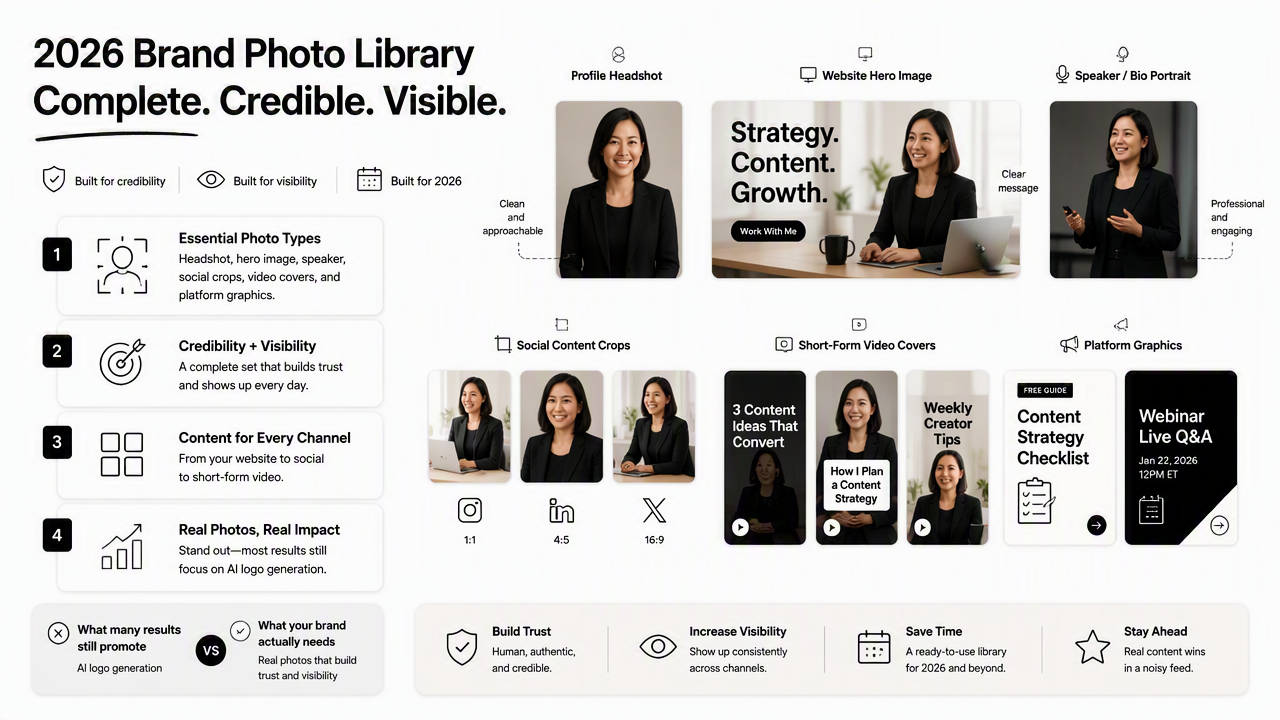
Many top search results still focus on AI logo generation, including Canva and Brandmark, while professional brand imagery needs a broader set than a logo or single template. A logo identifies a brand, but a person's image library creates trust across repeated digital encounters.
A balanced library can include:
- Primary profile headshot: LinkedIn, resume, company page, press page.
- Bio portrait: Podcast guest pages, speaker listings, newsletters.
- Website hero image: Homepage, sales page, booking page.
- Social authority image: LinkedIn posts, Instagram carousels, X profile content.
- Video cover image: TikTok, YouTube Shorts, Reels, webinar clips.
- Campaign image: Launches, ads, lead magnets, event promotions.
Website visuals need more negative space than profile photos. A website hero AI generator can help create wide compositions where text, buttons, and product messaging have room to breathe.
Short-form platforms need stronger contrast and simpler framing. A TikTok cover AI generator supports vertical-first presentation, while a YouTube thumbnail AI generator can guide bolder facial expression, sharper hierarchy, and clearer topic framing.
What to expect in 2027
Brand image generation is likely to move toward more persistent identity controls, stronger editing precision, and tighter integration with marketing design tools. The winning workflow will not be "generate and post." It will be plan, generate, select, adapt, test, and refresh.
What mistakes weaken AI-generated brand image sets?
AI-generated brand image sets become weaker when images look inconsistent, over-edited, channel-blind, or disconnected from the person's real-world presence. The most common problem is not poor image quality; it is a polished set that feels generic or mismatched to the audience.
Common mistakes include:
- Too many styles: Editorial, corporate, cinematic, and lifestyle images mixed without a shared system.
- Unrealistic grooming or features: Skin, hair, teeth, hands, or facial structure that no longer feel credible.
- Wrong crop for the channel: A great portrait that fails as a banner, thumbnail, or vertical cover.
- No wardrobe logic: Random outfits that suggest different roles, industries, or income levels.
- No review grid: Images approved one by one instead of checked as a complete set.
A safer review method uses three passes. First, check likeness. Second, check channel fit. Third, check the full grid for repeated colors, backgrounds, and emotional tone.
The best final set usually includes fewer images than the first generated batch. Selection is a brand decision, not a storage decision. Strong sets keep only images that can be used immediately on a profile, site, campaign, or social channel.
FAQ
Can AI-generated photos replace a professional photoshoot?
AI-generated photos can replace some routine brand image needs, especially profile refreshes, social content, speaker bios, and campaign variations. A traditional photoshoot may still be better for high-budget campaigns, regulated industries, physical product shoots, or situations where exact location, wardrobe, and lighting control are required.
How many images should a brand image set include?
A useful starter set usually includes 8 to 15 final images across profile, bio, website, and social formats. Larger sets can work for creators or founders with frequent content needs, but quality matters more than volume. Each image should have a clear publishing destination.
Are AI brand photos acceptable for LinkedIn?
AI brand photos can work on LinkedIn when the person remains recognizable, professional, and realistic. The safest approach uses clean lighting, natural expressions, industry-appropriate wardrobe, and a background that would make sense in a real professional setting. Over-stylized images can reduce trust.
What should be prepared before using an AI photo generator?
Strong preparation includes clear reference images, target channels, preferred outfits, background ideas, brand colors, and examples of acceptable tone. The input should also define what the image must avoid, such as unrealistic editing, distracting props, or crops that leave no room for platform overlays.
Conclusion
An artificial intelligence photo generator for brand image sets works best as a brand planning tool, not a novelty portrait maker. The next step is to define channels, build a simple style grid, generate controlled variations, and keep only images that support a real profile, page, or campaign. For professionals ready to turn one image into a consistent visual library, Looktara offers a practical place to start. Visit looktara.com and build the first set around one clear goal: stronger recognition everywhere the brand appears.
Generated by EarlySEO.com