
TL;DR
A strong pharmacist headshot should look clinical, calm, and approachable, not overly corporate or overly casual. The best results come from clear selfies, healthcare-appropriate attire, a simple background, and consistent use across LinkedIn, clinic pages, resumes, and speaker bios.
A pharmacist's profile photo often shapes trust before a patient, hiring manager, clinic director, or conference organizer reads a single credential. An AI headshot for pharmacists can create a polished healthcare portrait from everyday selfies, making it useful for PharmD professionals, pharmacy managers, residents, locum pharmacists, and clinic teams that need consistent images fast. Looktara supports this need with professional headshot generation for career and profile use, while looktara.com gives teams a simple place to start when updating public-facing photos.
Table of Contents
What is an AI headshot for pharmacists?
An AI headshot for pharmacists is a generated professional portrait made from uploaded photos and styled to fit healthcare settings, such as retail pharmacy, hospital pharmacy, ambulatory care, academia, or telehealth. It should communicate competence, warmth, and patient safety through attire, expression, lighting, and background.
AI pharmacist headshot: a professional image generated or enhanced by artificial intelligence to help pharmacists present a credible, approachable identity across digital profiles.
Unlike a casual selfie, a pharmacist headshot has a job to do. It needs to look accurate enough for recognition, formal enough for credentials, and friendly enough for patient-facing work.
Key insight: The best healthcare headshot is not the most glamorous image. It is the image that makes a pharmacist look qualified, calm, and easy to approach.
A 2025 Scientific Reports study by Nouar AlDahoul, Talal Rahwan, and Yasir Zaki examined how AI-generated faces can influence gender stereotypes and racial homogenization. For pharmacist portraits, that makes human review important. Final images should preserve real identity, natural facial features, and professional context rather than creating a generic healthcare look.
Pharmacist headshot use cases in 2026
Pharmacists use professional AI portraits anywhere a trusted healthcare identity matters.
- LinkedIn: hiring, networking, recruiter screening, residency connections
- Clinic or pharmacy website: patient confidence and team consistency
- Conference bios: speaker pages, panel promotions, poster sessions
- CVs and resumes: where a photo is appropriate by region or employer norms
- Telehealth platforms: provider directories and patient portals
- Professional memberships: association profiles and award submissions
For broader professional profile updates beyond pharmacy, the AI resume headshot generator can also fit career-facing image needs.
How should pharmacists prepare photos before uploading?
Pharmacists should prepare source photos by choosing clear, recent selfies with good light, neutral expressions, visible facial features, and no distracting filters. The strongest workflow is: 1. collect 8 to 15 images, 2. remove blurry shots, 3. include varied angles, 4. avoid heavy edits, 5. review outputs carefully.
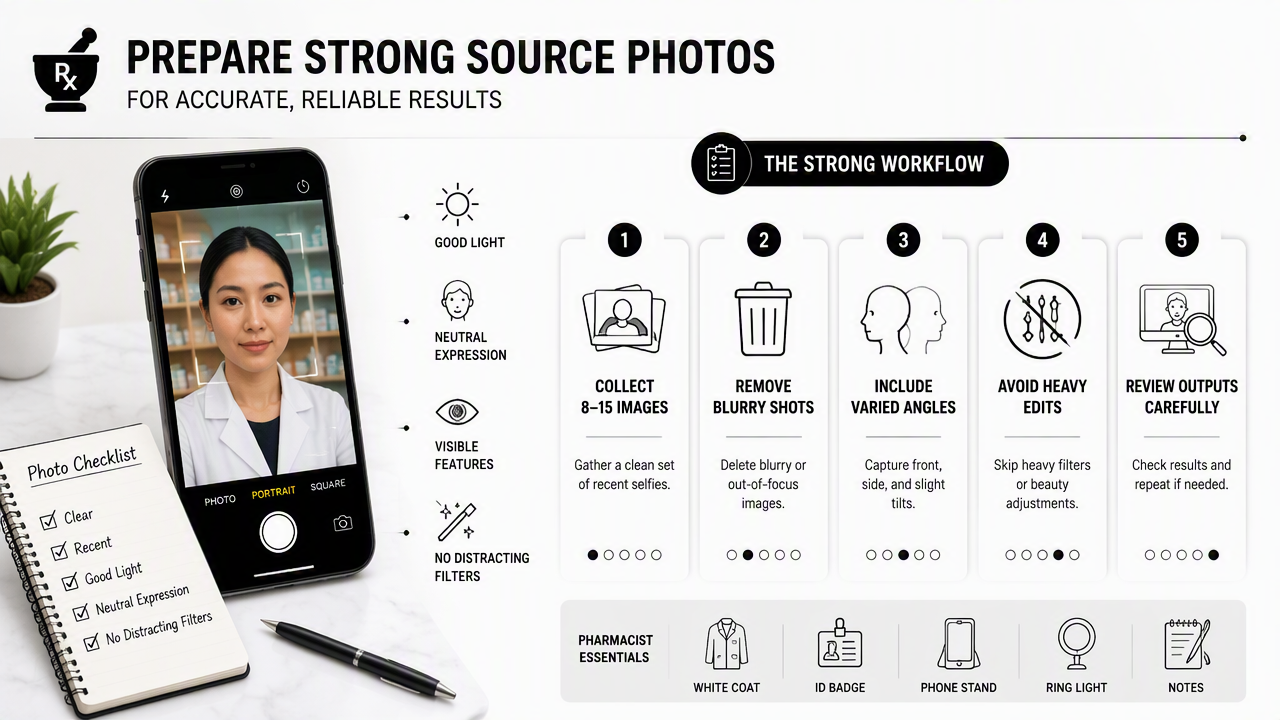
Good AI output starts with honest input. A model can improve lighting, clothing style, background, and framing, but it works best when the source photos already show the real face clearly.
Key insight: A polished final headshot depends less on expensive equipment and more on clean input photos with accurate face detail.
Before-upload checklist for pharmacists
Use this checklist before generating a professional portrait:
- Choose recent photos from the past 12 to 24 months.
- Include front-facing and slight-angle images.
- Use natural light or bright indoor light.
- Keep glasses on if they are normally worn at work.
- Avoid masks, hats, sunglasses, and heavy face filters.
- Remove photos with harsh shadows or motion blur.
- Include a calm smile and a neutral expression.
- Select images that match current hair, facial hair, and general appearance.
Selfies taken against a simple wall often perform better than crowded event photos. Group photos, badge lanyards covering the face, and highly edited social images can reduce accuracy.
Source photo quality guide
| Source photo factor | Best choice | Avoid |
|---|---|---|
| Lighting | Soft daylight or bright indoor light | Dim rooms, backlighting, colored lights |
| Face angle | Front-facing and slight turns | Extreme side angles or tilted selfies |
| Expression | Relaxed, alert, mild smile | Exaggerated grin or stern glare |
| Accessories | Everyday glasses, simple jewelry | Sunglasses, hats, face-obscuring items |
| Image style | Unfiltered, high-resolution photo | Beauty filters, heavy smoothing, low-res crops |
A pharmacist should look like the same person patients or colleagues will meet. Any generated image that changes facial structure, skin tone, age, or recognizable features should be rejected.
What should a pharmacist headshot show?
A pharmacist headshot should show clinical professionalism, approachability, and role clarity through modest attire, clean grooming, direct eye contact, and a simple medical or neutral background. The image should feel trustworthy without looking stiff, overly edited, or disconnected from daily pharmacy practice.
Attire, coat, badge, and background choices
Clothing should match the pharmacist's setting. A white coat works well for clinical, academic, hospital, and patient-facing roles. Business-casual clothing can fit industry, managed care, consulting, or startup roles.
- Retail pharmacist: white coat or clean business-casual top with a neutral background
- Hospital pharmacist: white coat, light clinical backdrop, minimal accessories
- Pharmacy manager: blazer, collared shirt, or polished blouse
- Academic pharmacist: white coat, blazer, or institution-friendly professional attire
- Entrepreneur pharmacist: smart business attire with a warm, brand-friendly style
Badges require care. A visible badge can add realism, but it may expose employer information, ID numbers, or patient-area access details. A safer option is a plain coat without readable credentials unless the employer has approved the image.
Recommended styling matrix
| Element | Best pharmacist choice | Why it works |
|---|---|---|
| Facial expression | Soft smile or calm neutral look | Signals confidence and patient comfort |
| Background | Light gray, soft white, clinic-style blur | Keeps attention on the face |
| Clothing | White coat, blazer, or neat professional top | Matches healthcare expectations |
| Framing | Head and shoulders | Fits LinkedIn, directories, and bios |
| Retouching | Light correction only | Keeps identity realistic |
A clinical headshot should not look like a fashion campaign. Subtle lighting, natural skin texture, and simple composition usually outperform dramatic edits for healthcare trust.
How Looktara handles pharmacist headshots
The Looktara platform helps pharmacists turn everyday photos into professional portraits that can fit healthcare, LinkedIn, resume, and clinic profile use. Its value is speed and consistency, especially for pharmacy teams that need aligned photos without booking separate studio sessions.
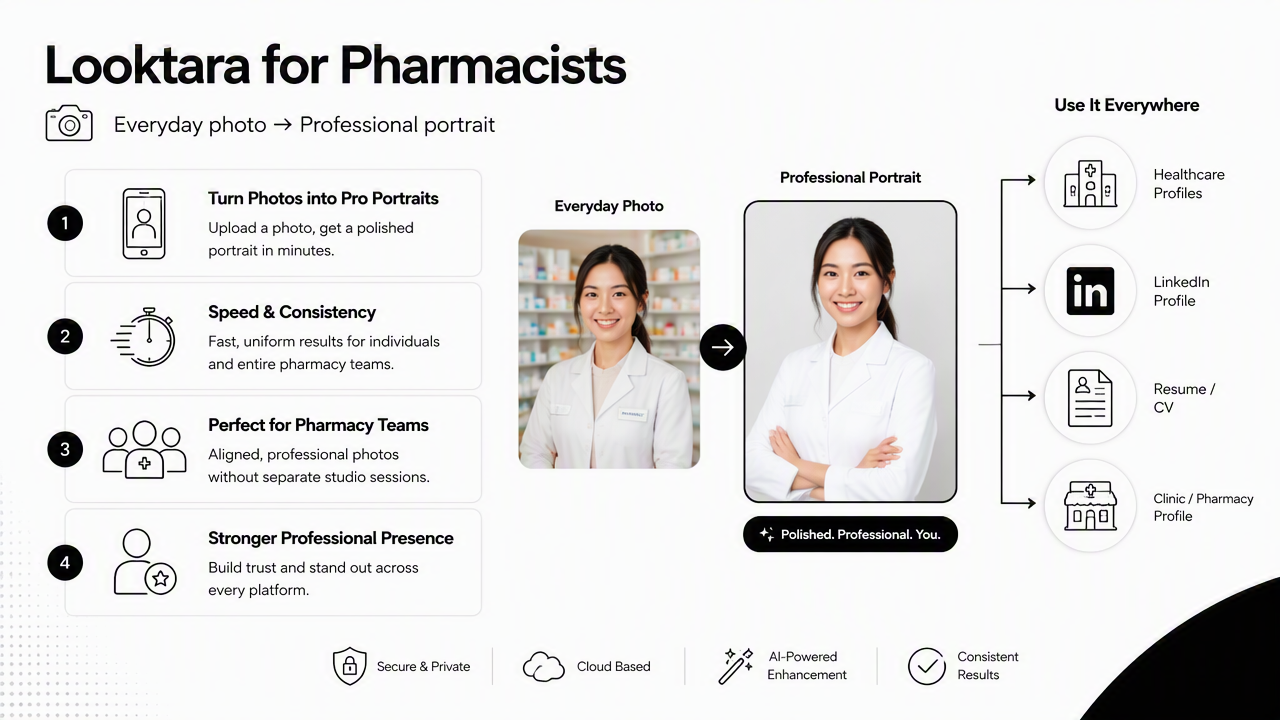
For an individual pharmacist, the practical goal is a headshot that looks current, credible, and easy to place across professional channels. For a clinic, health system, or independent pharmacy, the bigger value is consistency: similar lighting, framing, and polish across the whole team.
Looktara is best used as part of a careful review process. A pharmacist or manager should select only images that preserve identity, match the intended role, and meet workplace photo policies. Visit looktara.com when a fast professional update is needed for career or brand profiles.
AI headshot versus photographer for pharmacy use
| Option | Best fit | Strength | Tradeoff |
|---|---|---|---|
| AI-generated headshot | Fast profile updates, remote teams, budget-conscious professionals | Quick, convenient, consistent styling | Requires careful review for realism |
| Traditional photographer | Executive portraits, employer campaigns, printed marketing | Human direction and controlled lighting | Higher cost and scheduling time |
| Smartphone portrait | Temporary internal use | Immediate and familiar | Often lacks polish and consistency |
A photographer still makes sense for major brand campaigns, pharmacy ownership announcements, or printed advertising. AI works especially well when the need is digital, fast, and repeated across many staff members.
Who should pick which option
Different pharmacy situations call for different image workflows.
- New graduates and residents: AI headshots can help update LinkedIn, CV pages, and residency profiles quickly.
- Pharmacy managers: consistent team portraits can support website and directory updates.
- Independent pharmacy owners: a warmer portrait style can support local trust and community branding.
- Hospital teams: a uniform background and coat style can help staff pages look organized.
- Conference speakers: a polished digital headshot can improve event listings and promotional materials.
The safest choice is the one that matches the visibility of the use case. Higher-stakes campaigns deserve more review, while routine digital profiles can often move faster.
Where should pharmacists use the final image?
Pharmacists should use the final headshot on platforms where professional identity, credibility, and recognition matter, including LinkedIn, employer websites, clinic directories, conference bios, telehealth profiles, resumes where appropriate, and pharmacy association pages. Consistency across these placements helps colleagues and patients recognize the same professional persona.
Profile placement priorities
The best first placement is usually LinkedIn because it affects recruiter searches, peer networking, and professional visibility. Employer directories come next because patients often check staff profiles before visiting a clinic or pharmacy.
- Update LinkedIn with the most polished head-and-shoulders version.
- Use the same or similar image for clinic and pharmacy team pages.
- Add the portrait to conference bios and speaker submissions.
- Keep a square crop for social platforms and a vertical crop for press kits.
- Store the final file with a clear name, such as
firstname-lastname-pharmacist-headshot.jpg.
File consistency matters. A pharmacy team should keep image size, background tone, and crop style aligned across staff pages.
What to expect in 2027
Professional headshots will likely become more standardized across healthcare profiles as telehealth, online scheduling, and provider directories keep growing. Pharmacists may need image sets rather than one image: clinical, LinkedIn, speaker, and brand-friendly versions.
AI review standards will also matter more. The 2025 research on AI-generated faces and stereotyping shows why healthcare professionals should check representation, realism, and fairness before publishing generated portraits. Pharmacy organizations may create clearer rules for badges, coats, retouching, and identity accuracy.
Frequently asked questions
A FAQ, short for frequently asked question, is a curated list of questions and answers that addresses important or commonly misunderstood parts of a topic. For pharmacist headshots, the most common concerns involve attire, realism, workplace approval, and where the final image belongs.
Should a pharmacist wear a white coat in an AI headshot?
A white coat is a strong choice for clinical, hospital, retail, and academic pharmacy roles because it signals healthcare context quickly. Business attire may fit industry, consulting, ownership, or executive roles better. The best choice should match the pharmacist's daily work setting and employer expectations.
Can a badge appear in a pharmacist headshot?
A badge can make a headshot feel realistic, but readable details may create privacy or workplace policy concerns. A safer image uses a plain coat, blurred badge, or no badge at all. Employer approval is smart when the photo appears on a public clinic, hospital, or pharmacy website.
Is an AI-generated headshot acceptable for LinkedIn?
An AI-generated portrait can work well on LinkedIn when it looks realistic, current, and professional. The image should preserve the pharmacist's actual appearance and avoid obvious artificial smoothing or exaggerated styling. A natural head-and-shoulders crop with a calm expression usually fits LinkedIn best.
How many final headshots should a pharmacist keep?
Most pharmacists benefit from three final versions: a LinkedIn crop, a clinic-directory crop, and a speaker-bio or press version. Each should look consistent but not identical if the platforms have different dimensions. Keeping the original high-resolution file helps with future resizing.
Conclusion
A strong pharmacist portrait should make clinical credibility feel human. The best process is simple: start with clear recent selfies, choose healthcare-appropriate attire, avoid exposing sensitive badge details, select a calm expression, and publish the final image consistently across professional channels. For a polished update without a studio appointment, an AI headshot for pharmacists created with Looktara can help pharmacy professionals and teams refresh profile images quickly. Head to looktara.com, generate several options, then choose the version that best matches real-world professional presence.
Generated by EarlySEO.com